


1.1单元总览Unit Overview
What Do We Learn in Unit 1? / 第一单元学什么?
微积分研究“变化”,而研究变化的第一个工具叫极限。本章回答三个问题:
- What does it mean for \(f(x)\) to approach a value? “\(f(x)\) 趋近于某个值”到底是什么意思?
- How do we compute limits—from graphs, tables, and algebra? 怎样用图像、表格和代数方法求极限?
- What does it mean for a function to be continuous, and what types of discontinuity are there? 函数“连续”是什么意思?间断点分为哪几类?
Learning Objectives / 学习目标
学完本章后,你应该能够:
- Explain the idea of a limit and its notation.
理解极限思想并正确使用极限记号。 - Evaluate one-sided limits and decide whether a limit exists.
求单侧极限,并判断极限是否存在。 - Estimate limits from graphs and tables.
从图像和表格估计极限。 - Apply limit laws and algebraic techniques (factoring, rationalizing, combining fractions).
使用极限运算法则与代数技巧(因式分解、有理化、通分)求极限。 - Apply the Squeeze Theorem.
使用夹逼定理。 - Analyze infinite limits, limits at infinity, and asymptotes.
分析无穷极限、无穷远处的极限与渐近线。 - Determine continuity and classify discontinuities.
判断连续性并区分间断点类型。 - Apply the Intermediate Value Theorem.
使用介值定理。
1.2引入:极限是什么The Idea of a Limit
Scene 1: The Speedometer Paradox / 场景一:测速仪悖论
A speed camera says you passed it at exactly \(t=3\) seconds, and your speed at that instant was 30 m/s. But speed is
and “one instant” has zero time and zero distance. \(\frac{0}{0}\) is meaningless. So what does “speed at \(t=3\)” mean?
测速仪说你在 \(t=3\) 这一瞬间的速度是 30 m/s。可是速度 \(=\) 距离 \(\div\) 时间,而“一瞬间”的时间是 0、距离也是 0,\(\frac{0}{0}\) 没有意义。那“\(t=3\) 时的速度”到底指什么?
解决办法是:不问“那一瞬间”,改问“那一瞬间附近”。设 \(t\) 秒时的位置为 \(s(t)=5t^2\)(米),算 \(t=3\) 到 \(t=3+h\) 的平均速度。 这里 \(h\) 是时间段的长度(\(h\ne0\)):这段时间内位置变化了 \(s(3+h)-s(3)\) 米,用时 \(h\) 秒,所以
例如时间段 \([3,\,3.1]\),\(h=0.1\):\(s(3)=5\cdot3^2=45\),\(s(3.1)=5\cdot3.1^2=48.05\),
\(h\) 取 \(0.01\)、\(0.001\) 时同样计算,得到下表:
| 时间段 | \([3,\,3.1]\) | \([3,\,3.01]\) | \([3,\,3.001]\) | \(\cdots\) |
| 平均速度 (m/s) | \(30.5\) | \(30.05\) | \(30.005\) | \(\cdots\) |
对一般的 \(h\) 也可以算出来:展开 \(s(3+h)=5(9+6h+h^2)=45+30h+5h^2\),所以
表中的三个数正是 \(h=0.1,\ 0.01,\ 0.001\) 时 \(30+5h\) 的值。\(h\) 越接近 \(0\),\(30+5h\) 越接近 \(30\)。 \(h\) 不能等于 \(0\)(分母不能为 \(0\)),但可以任意接近 \(0\),下面所说的“极限”描述的就是这种情形。章末练习 Part E 第 5 题用的是同样的方法。
The average speeds approach \(30\). We call \(30\) the limit of the average speeds—and that is what “speed at an instant” means.
时间段越缩越短,平均速度越来越趋近 30。我们把 30 叫做这些平均速度的极限——“瞬时速度”指的就是它。(这个想法在第二章会发展为“导数”。)
Scene 2: The Hole in the Graph / 场景二:图上的洞
Consider
At \(x=1\) the function is undefined (\(\tfrac{0}{0}\)). But for every other \(x\),
函数在 \(x=1\) 处没有定义,但在其它任何地方它就是直线 \(y=x+1\)——图像是一条挖了一个洞的直线:
As \(x\) gets closer and closer to \(1\) (from either side), \(f(x)\) gets closer and closer to \(2\). The function is undefined at \(x=1\), but the trend is clear.
\(x\) 从两边越来越靠近 1 时,\(f(x)\) 越来越靠近 2。函数在 \(x=1\) 处无定义,但趋势很明确。
A limit describes the trend of \(f(x)\) near a point—not the value at the point.
极限描述的是函数在一点附近的趋势,而不是那一点本身的函数值。 测速仪问题和图上的洞,问的都是同一件事:“\(x\) 靠近 \(a\) 时,\(f(x)\) 趋于多少?”
1.3极限的概念与记号Limit Notation and Basic Idea
If \(f(x)\) gets arbitrarily close to a single number \(L\) as \(x\) approaches \(a\) from both sides, we write
当 \(x\) 从两侧趋近 \(a\) 时,若 \(f(x)\) 无限接近同一个数 \(L\),就记 \(\displaystyle\lim_{x\to a} f(x) = L\)。
Note: \(x\to a\) means “approaches, but need not equal”—the limit depends only on the values of \(f(x)\) for \(x\ne a\).
注意:\(x\to a\) 表示“趋近但不必等于”;极限只取决于 \(x\ne a\) 时 \(f(x)\) 的值。
极限与函数值是两回事,四种组合都可能发生:极限存在而函数值不存在(图上的洞)、两者都存在但不相等、两者相等(这就是第 1.11 节的“连续”)、极限不存在。
Example 1 / 例题 1
Evaluate
and explain why the answer is not “undefined”.
解 Solution
直接代入 \(x=3\) 得 \(\frac{0}{0}\),说明不能直接代入求值,但不代表极限不存在。极限看的是 \(x\ne 3\) 时的行为,此时可以约分:
所以
答:\(6\)。函数在 \(x=3\) 处无定义,但极限仍然存在。
Example 2 / 例题 2
Let
Find \(\displaystyle\lim_{x\to 2} g(x)\) and \(g(2)\).
解 Solution
求极限时只看 \(x\ne 2\) 的部分:\(g(x)=x+1 \to 3\)。所以
两者不相等,这是允许的。极限由“附近”决定,函数值由“那一点”决定,两者互不影响。 (预告:这种“极限 \(\ne\) 函数值”的点,1.12 节里叫可去间断点。)
- Evaluate \(\displaystyle\lim_{x\to 4}\frac{x^2-16}{x-4}\).
核对答案
\(8\) - Let \(g(x)=\begin{cases} 2x, & x\ne 1\\ 7, & x=1\end{cases}\). Find \(\displaystyle\lim_{x\to 1} g(x)\) and \(g(1)\).
核对答案
\(\displaystyle\lim_{x\to 1}g(x)=2\);\(g(1)=7\) - True or False: if \(f(a)\) is undefined, then \(\displaystyle\lim_{x\to a}f(x)\) cannot exist.
若 \(f(a)\) 无定义,则极限一定不存在。核对答案
False(极限看附近,不看那一点;例:图上的洞) - Evaluate \(\displaystyle\lim_{x\to 0}\frac{x^2+2x}{x}\).
核对答案
\(2\)
1.4单侧极限与极限存在性One-Sided Limits
有的函数在一点左右两侧趋于不同的值,这时要分别求左右极限。
Existence criterion / 极限存在的判据:
The limit exists exactly when both one-sided limits exist and agree.
左右极限都存在且相等,极限才存在。
Example 3 / 例题 3
Let \(f(x)=\dfrac{|x|}{x}\). Find \(\displaystyle\lim_{x\to 0^-} f(x)\), \(\displaystyle\lim_{x\to 0^+} f(x)\), and \(\displaystyle\lim_{x\to 0} f(x)\).
解 Solution
关键是拆开绝对值:
所以
左右极限存在但不相等,故 \(\displaystyle\lim_{x\to 0} f(x)\) 不存在(DNE)。
答:\(-1\);\(1\);不存在。绝对值里的式子在该点等于 \(0\) 时(如本题的 \(|x|\) 在 \(x=0\) 处),要先分左右讨论。
Example 4 / 例题 4
Let
Does \(\displaystyle\lim_{x\to 2} f(x)\) exist?
解 Solution
分段函数在分段点处必须分左右检查:
左右相等,所以极限存在:
答:存在,等于 \(4\)。两段的表达式不同,不代表极限不存在;判断时以左右极限的数值为准。
- \(f(x)=\begin{cases} x+3, & x<1\\ 2x, & x\ge 1\end{cases}\). Find both one-sided limits at \(x=1\) and decide whether \(\displaystyle\lim_{x\to 1}f(x)\) exists.
求两个单侧极限,并判断整体极限是否存在。核对答案
左极限 \(4\),右极限 \(2\);不相等,\(\displaystyle\lim_{x\to 1}f(x)\) 不存在 - Evaluate \(\displaystyle\lim_{x\to 3}\frac{|x-3|}{x-3}\), or explain why it does not exist.
计算该极限,若不存在请说明。核对答案
不存在(左 \(-1\),右 \(1\)) - \(g(x)=\begin{cases} 5-x^2, & x<0\\ 5+x, & x\ge 0\end{cases}\). Find \(\displaystyle\lim_{x\to 0} g(x)\). / 求该极限。
核对答案
\(5\)(左右都是 \(5\)) - True or False: if \(\displaystyle\lim_{x\to a^+}f(x)\) exists, then \(\displaystyle\lim_{x\to a}f(x)\) exists.
右极限存在则整体极限存在,对吗?核对答案
False(还需左极限存在且与之相等)
1.5从图像与表格估计极限Limits from Graphs and Tables
AP 考试中有一类极限题不给公式,只给图或表。读图求极限的方法:沿曲线从左右两侧趋近该 \(x\) 值,看 \(y\) 值趋于多少。空心圈、实心点只影响函数值,不影响极限。
Example 5 / 例题 5
Use the graph of \(g\) above (图 3) to find:
解 Solution
(a) 沿左支 \(y=x+3\) 趋近 \(x=0\),\(y\) 值趋于 \(3\):左极限 \(=3\)。
(b) 沿右支 \(y=3-x\) 趋近 \(x=0\),\(y\) 值也趋于 \(3\):右极限 \(=3\)。
(c) 左右相等,\(\displaystyle\lim_{x\to 0} g(x) = 3\)——尽管 \((0,3)\) 是个空心圈。
(d) 函数值看实心点:\(g(0)=1\)。
答:(a) \(3\) (b) \(3\) (c) \(3\) (d) \(1\)。极限是 3、函数值是 1,互不影响。
Example 6 / 例题 6(表格)
The table shows values of \(f(x)=\dfrac{\sin x}{x}\) (\(x\) in radians):
| \(x\) | \(\pm 0.5\) | \(\pm 0.1\) | \(\pm 0.01\) | \(\pm 0.001\) |
| \(f(x)\) | \(0.9589\) | \(0.9983\) | \(0.99998\) | \(0.9999998\) |
Estimate \(\displaystyle\lim_{x\to 0}\frac{\sin x}{x}\).
解 Solution
\(x\) 从两侧逼近 \(0\) 时,表中函数值都越来越接近 \(1\),所以估计
答:约为 \(1\)(the limit appears to be 1)。这是本章最著名的极限,值得记住;1.8 节会解释它为什么成立。 表格题的答题用语注意:表格只能估计(estimate)极限,AP 答题时写 “the limit appears to be 1”。
- Use Figure 3 to find \(\displaystyle\lim_{x\to 3^-} g(x)\), \(\displaystyle\lim_{x\to 3^+} g(x)\), and \(g(3)\).
用图 3 求这三个值。核对答案
\(\displaystyle\lim_{x\to 3^-}g(x)=0\);\(\displaystyle\lim_{x\to 3^+}g(x)=2\);\(g(3)=0\) - Use Figure 3 to decide whether \(\displaystyle\lim_{x\to 3} g(x)\) exists; justify.
用图 3 判断该极限是否存在,并说明理由。核对答案
不存在(左 \(0\ne\) 右 \(2\),跳跃) - Use Figure 3 to find \(\displaystyle\lim_{x\to -2} g(x)\). / 用图 3 求该极限。
核对答案
\(1\)(沿 \(y=x+3\),\(-2+3=1\)) The table gives values of \(h(x)=\dfrac{x^2-4}{x-2}\). Estimate \(\displaystyle\lim_{x\to 2} h(x)\).
用下表估计该极限:\(x\) \(1.9\) \(1.99\) \(2.01\) \(2.1\) \(h(x)\) \(3.9\) \(3.99\) \(4.01\) \(4.1\) 核对答案
The limit appears to be \(4\):\(x\) 从左侧(\(1.9,\ 1.99\))和右侧(\(2.1,\ 2.01\))逼近 \(2\) 时,\(h(x)\) 都越来越接近 \(4\)
1.6极限运算法则Limit Laws
图像和表格是“看”,从这一节开始“算”。计算的依据是:极限运算与四则运算兼容。
Suppose \(\displaystyle\lim_{x\to a} f(x) = L\) and \(\displaystyle\lim_{x\to a} g(x) = M\). Then
| Sum / Difference: | \(\displaystyle\lim_{x\to a}\,[f(x)\pm g(x)] = L \pm M\) |
| Constant Multiple: | \(\displaystyle\lim_{x\to a}\, c\,f(x) = cL\) |
| Product: | \(\displaystyle\lim_{x\to a}\, f(x)\,g(x) = LM\) |
| Quotient: | \(\displaystyle\lim_{x\to a}\frac{f(x)}{g(x)} = \frac{L}{M} \quad (M\ne 0)\) |
| Power / Root: | \(\displaystyle\lim_{x\to a}\,[f(x)]^n = L^n,\qquad \lim_{x\to a}\sqrt[n]{f(x)} = \sqrt[n]{L}\) |
Limits distribute over \(+,\,-,\,\times,\,\div\) and powers/roots, provided the quotient law has \(M\ne 0\) and an even root has \(L>0\).
极限可以拆进加减乘除和乘方开方;条件是:商法则要求分母极限非零,开偶次方根要求 \(L>0\)。
What the Laws Say / 法则的含义
\(\displaystyle\lim_{x\to a} f(x)=L\) 的意思是:\(x\) 靠近 \(a\) 时,\(f(x)\) 靠近 \(L\)。法则说的是:两个分别靠近 \(L\)、\(M\) 的数,相加、相减、相乘、相除之后,结果靠近 \(L+M\)、\(L-M\)、\(LM\)、\(\frac{L}{M}\)(相除时要求 \(M\ne0\))。 例如 \(L=5\)、\(M=-2\):\(f(x)\) 在 \(5\) 附近时,\(2f(x)\) 在 \(10\) 附近;\(g(x)\) 在 \(-2\) 附近时,\(3g(x)\) 在 \(-6\) 附近;所以 \(2f(x)-3g(x)\) 在 \(10-(-6)=16\) 附近。 \(f(x)\) 与 \(5\) 的差、\(g(x)\) 与 \(-2\) 的差都可以任意小,\(2f(x)-3g(x)\) 与 \(16\) 的差也就可以任意小,即 \(\displaystyle\lim_{x\to a}[2f(x)-3g(x)]=16\)。乘积、商、乘方的法则是同样的道理。
使用前提:拆开后的每个极限都必须存在。法则的条件是 \(L\)、\(M\) 都是确定的数。只要有一个极限不存在,就不能拆。 例如 1.8 节例题 12 的 \(x^2\sin\frac{1}{x}\):\(x\to 0\) 时 \(\sin\frac{1}{x}\) 没有极限,不能用乘积法则拆成 \(\displaystyle\lim_{x\to 0}x^2\cdot\lim_{x\to 0}\sin\frac{1}{x}\)。 但不能拆不等于极限不存在:这个极限存在(等于 \(0\)),要改用夹逼定理来求。
商法则在 \(M=0\) 时不能用。这时要看分子的极限:
- 分子的极限也是 \(0\):代入得 \(\frac{0}{0}\),是不定式,要先做代数变形(因式分解、有理化、通分)再求,见 1.7 节。例题 1 就是这种情形。
- 分子的极限不是 \(0\):代入得 \(\frac{\text{非零数}}{0}\),函数值的绝对值无限增大,极限不存在(趋于 \(+\infty\) 或 \(-\infty\)),见 1.9 节。
Example 7 / 例题 7
Given \(\displaystyle\lim_{x\to a} f(x) = 5\) and \(\displaystyle\lim_{x\to a} g(x) = -2\), evaluate:
解 Solution
逐条应用法则:
(a) \(2(5) - 3(-2) = 10 + 6 = 16\).
(b) 分母极限 \(-2\ne 0\),商法则可用:\(\dfrac{5}{-2} = -\dfrac{5}{2}\).
(c) \((-2)^2 = 4\).
答:(a) \(16\) (b) \(-\dfrac{5}{2}\) (c) \(4\)。
Polynomials and Rational Functions / 多项式与有理函数:直接代入
先看两个最简单的极限:
第一个:常数函数的值总是 \(c\),\(x\) 靠近哪里都一样;第二个:函数值就是 \(x\) 本身,\(x\) 靠近 \(a\),函数值就靠近 \(a\)。 从这两个极限出发,反复使用和差、常数倍、乘方(乘积)法则,可以把多项式逐项拆开。以 \(p(x)=x^3-2x+1\) 为例:
每一步拆开的极限都存在,所以每一步都合法。结果正是把 \(x=a\) 代入 \(p(x)\) 所得的值。任何多项式都可以这样逐项拆开,所以多项式求极限可以直接代入。 有理函数 \(\frac{p(x)}{q(x)}\) 是两个多项式相除:分子、分母的极限分别是 \(p(a)\)、\(q(a)\),只要 \(q(a)\ne0\),就可以用商法则:
\(q(a)=0\) 时不能直接代入,按上面“商法则在 \(M=0\) 时不能用”的两种情形处理。
Example 8 / 例题 8
Evaluate
解 Solution
多项式,直接代入:
答:\(5\)。求极限的第一步是先试代入:由上面的推导,多项式(以及分母不为零处的有理函数)代入所得的值就是极限。1.11 节会把“极限等于函数值”这种性质叫做连续。分段函数在分段点处要分左右求,不能直接代入。
Given \(\displaystyle\lim_{x\to a} f(x)=4\) and \(\displaystyle\lim_{x\to a} g(x)=-1\), find:
已知上述两个极限,求:
- \(\displaystyle\lim_{x\to a}\,[f(x) + 3g(x)]\)
核对答案
\(4+3(-1)=1\) - \(\displaystyle\lim_{x\to a}\, f(x)\,g(x)\)
核对答案
\(4\times(-1)=-4\) - \(\displaystyle\lim_{x\to a}\sqrt{f(x)}\)
核对答案
\(\sqrt{4}=2\) - \(\displaystyle\lim_{x\to -1}\,(x^2+3x)\)
核对答案
\((-1)^2+3(-1)=-2\)
1.7代数求极限Algebraic Techniques
代入得到 \(\frac{0}{0}\) 时还不能下结论:\(\frac{0}{0}\) 是不定式。对有理式和根式,通常先做代数变形、约去公因式,再代入。常用三种方法:
- Factor / 因式分解:factor top and bottom, cancel the common factor.
分子分母分解后约去公因式。 - Rationalize / 有理化:with square roots, multiply by the conjugate.
带根号时,乘“共轭”消掉根号差。 - Combine fractions / 通分:merge a compound fraction into a single fraction.
繁分式先合并成一个分式。
One goal for all three: cancel the factor that creates \(\frac00\), then substitute again.
三种方法的目的相同:约去产生 \(\frac{0}{0}\) 的公因式,然后重新代入。
Example 9 / 例题 9(因式分解)
Evaluate
解 Solution
代入得 \(\frac{0}{0}\),分解分子:
答:\(5\)。
Example 10 / 例题 10(有理化)
Evaluate
解 Solution
代入得 \(\frac{0}{0}\)。分子有根号差,乘共轭 \(\sqrt{x+4}+2\):
现在可以代入了:
答:\(\dfrac{1}{4}\)。
Example 11 / 例题 11(通分)
Evaluate
解 Solution
分子先通分:
于是
答:\(-\dfrac{1}{9}\)。
Evaluate. / 计算下列极限。
- \(\displaystyle\lim_{x\to 5}\frac{x^2-25}{x-5}\)
核对答案
\(10\) - \(\displaystyle\lim_{x\to 2}\frac{x^2+3x-10}{x-2}\)
核对答案
\(7\)(分子 \(=(x-2)(x+5)\)) - \(\displaystyle\lim_{x\to 0}\frac{\sqrt{x+9}-3}{x}\)
核对答案
\(\dfrac{1}{6}\) - \(\displaystyle\lim_{x\to 0}\frac{\dfrac{1}{x+2}-\dfrac{1}{2}}{x}\)
核对答案
\(-\dfrac{1}{4}\) - \(\displaystyle\lim_{x\to 2}\frac{x^3-8}{x-2}\)
核对答案
\(12\)(\(x^3-8=(x-2)(x^2+2x+4)\))
1.8夹逼定理The Squeeze Theorem
有些函数在某点附近振荡(如 \(\sin\frac{1}{x}\) 在 \(0\) 附近没有极限),但被两个函数上下夹住。若这两个函数的极限相同,中间的函数也有同一极限。
If
for all \(x\) near \(a\) (except possibly at \(a\)), and
then
If the two outer functions have the same limit, the middle function has that limit too. Typical use: “bounded function \(\times\) function \(\to 0\)” products.
上下两个函数极限相同,中间函数的极限也等于它;常用于“有界函数 \(\times\) 趋于 \(0\) 的函数”。
Example 12 / 例题 12
Evaluate
解 Solution
\(\sin\frac{1}{x}\) 在 \(0\) 附近振荡、没有极限,不能用乘法法则。但正弦值总在 \([-1,1]\) 内:
(各边同乘 \(x^2\):\(x\ne0\) 时 \(x^2>0\),乘以正数,不等号方向不变。)而
由夹逼定理,
答:\(0\)。
Why \(\frac{\sin x}{x}\to 1\) / 为什么 \(\frac{\sin x}{x}\to 1\)
1.5 节用表格估计出 \(\displaystyle\lim_{x\to 0}\frac{\sin x}{x}=1\),但表格只能估计。下面用夹逼定理证明它:找两个极限都是 \(1\) 的函数,把 \(\frac{\sin x}{x}\) 夹在中间。 这两个函数是 \(\cos x\) 和 \(1\),所需的不等式来自单位圆里三块面积的比较。
第一步:画图。先设 \(0<x<\frac{\pi}{2}\)。单位圆的圆心是 \(O\)、半径是 \(1\)。取圆上的点 \(A(1,0)\),从 \(OA\) 逆时针转过圆心角 \(x\)(弧度),得到圆上的点 \(P(\cos x,\sin x)\)。 过 \(A\) 作圆的切线(竖直线 \(x=1\)),延长 \(OP\),与切线交于点 \(T\)(图 5)。
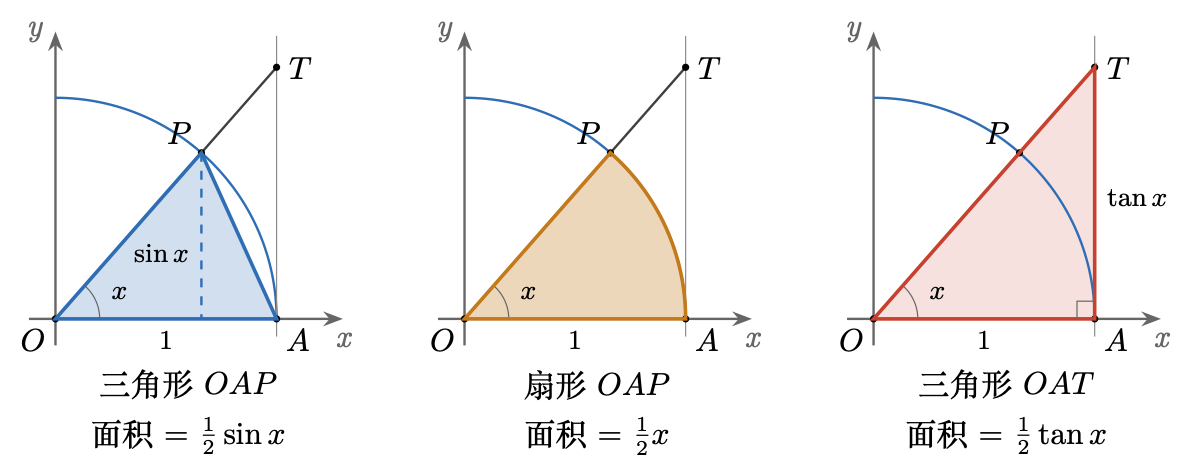
第二步:算三块面积。
- 三角形 \(OAP\):以 \(OA=1\) 为底,高是 \(P\) 到 \(x\) 轴的距离,也就是 \(P\) 的纵坐标 \(\sin x\)。面积 \(=\frac12\cdot1\cdot\sin x=\frac12\sin x\)。
- 扇形 \(OAP\):半径 \(1\)、圆心角 \(x\)。整个圆的圆心角是 \(2\pi\),扇形占整个圆的 \(\frac{x}{2\pi}\),面积 \(=\pi\cdot1^2\cdot\frac{x}{2\pi}=\frac12x\)。 (一般地,半径 \(r\)、圆心角 \(\theta\) 的扇形面积是 \(\frac12r^2\theta\)。)
- 三角形 \(OAT\):切线与半径垂直,所以 \(A\) 处是直角,底 \(OA=1\)。在直角三角形 \(OAT\) 中,\(\tan x=\dfrac{AT}{OA}=AT\),所以高 \(AT=\tan x\)。面积 \(=\frac12\cdot1\cdot\tan x=\frac12\tan x\)。
第三步:比较面积。从图 5 看,三角形 \(OAP\) 在扇形里面(弦 \(AP\) 在弧 \(AP\) 的内侧),扇形又在三角形 \(OAT\) 里面(弧 \(AP\) 在切线段 \(AT\) 的左侧)。所以
第四步:变形成夹逼的形式。各边乘以 \(2\),得 \(\sin x\le x\le\tan x\)。两个不等号分开处理:
- \(\sin x\le x\):两边除以 \(x\)(\(x>0\),不等号方向不变),得 \(\dfrac{\sin x}{x}\le 1\)。
- \(x\le\tan x=\dfrac{\sin x}{\cos x}\):两边乘以 \(\cos x\)(\(0<x<\frac{\pi}{2}\) 时 \(\cos x>0\)),得 \(x\cos x\le\sin x\);再除以 \(x\),得 \(\cos x\le\dfrac{\sin x}{x}\)。
合起来:
第五步:\(x<0\) 的情形。把 \(x\) 换成 \(-x\):\(\dfrac{\sin(-x)}{-x}=\dfrac{-\sin x}{-x}=\dfrac{\sin x}{x}\),\(\cos(-x)=\cos x\)。 即 \(\frac{\sin x}{x}\) 和 \(\cos x\) 都是偶函数,\(x\) 与 \(-x\) 处的值相同,所以 \(-\frac{\pi}{2}<x<0\) 时同一个不等式也成立。
第六步:用夹逼定理。\(x\to 0\) 时,圆上的点 \(P\) 趋于 \(A(1,0)\),它的横坐标 \(\cos x\to 1\);常数函数 \(1\) 的极限也是 \(1\)。 上下两个函数的极限都是 \(1\),由夹逼定理,
扇形面积 \(\frac12r^2\theta\) 要求角用弧度,所以这个结论也只在 \(x\) 用弧度时成立(1.5 节的表格就是按弧度算的)。 AP 考试中可以直接把这个极限当作已知结论使用;第二章推导 \(\sin x\) 的导数时要用到它。
- \(\displaystyle\lim_{x\to 0}\ x^2\cos\!\frac{1}{x}\)
核对答案
\(0\)(夹在 \(\pm x^2\) 之间) - \(\displaystyle\lim_{x\to 0}\ x^4\sin\!\frac{3}{x}\)
核对答案
\(0\)(夹在 \(\pm x^4\) 之间) - Given \(3-x^2 \le g(x) \le 3+x^2\) for all \(x\ne 0\), find \(\displaystyle\lim_{x\to 0} g(x)\).
由夹逼求该极限。核对答案
\(3\)(两侧夹逼函数极限都是 \(3\))
1.9无穷极限与垂直渐近线Infinite Limits and Vertical Asymptotes
代入时如果出现的是 \(\frac{\text{非零数}}{0}\)(不是 \(\frac{0}{0}\)),函数在这一点附近会趋于 \(+\infty\) 或 \(-\infty\)。代入得 \(\frac{0}{0}\) 的情形见本节最后的“找垂直渐近线”。
If \(f(x)\) grows or drops without bound as \(x\to a\) (possibly one-sided), we write
若 \(x\to a\)(或单侧)时 \(f(x)\) 无限增大或无限减小,记
The line \(x=a\) is then a vertical asymptote of \(f\). 此时直线 \(x=a\) 称为 \(f\) 的垂直渐近线。
Note: writing \(\infty\) describes the behavior; strictly speaking, the limit does not exist.
注意:写 \(\infty\) 是在描述“无限增大”这种行为,极限本身仍算“不存在”。
判断趋于 \(+\infty\) 还是 \(-\infty\),靠符号分析:看分子的符号、分母趋近 \(0\) 时的符号。
Example 13 / 例题 13
Evaluate
解 Solution
\(x\to 2\) 时分母 \((x-2)^2 \to 0\),且平方保证恒正;分子恒为 \(1>0\)。 正数除以越来越小的正数,结果无限增大:
答:\(\infty\)(两侧都趋于 \(+\infty\),\(x=2\) 是垂直渐近线)。
Example 14 / 例题 14(左右方向不同)
Analyze
解 Solution
\(x\to 3\) 时分子 \(\to 4 > 0\)。分母:
于是
答:左侧 \(-\infty\),右侧 \(+\infty\);\(x=3\) 是垂直渐近线。左右方向可以不同——所以无穷极限一律先分单侧。
Finding Vertical Asymptotes / 找垂直渐近线
有理函数的垂直渐近线只可能出现在分母为零的点,但分母为零的点不一定是垂直渐近线。 如果代入得到 \(\frac{0}{0}\),说明分子、分母有公因式;约掉公因式以后,这一点可能只是一个洞,例如图 1 中 \(\frac{x^2-1}{x-1}\) 在 \(x=1\) 处。找垂直渐近线分三步:
- 找出分母为零的点;
- 把分子、分母因式分解,约去公因式;
- 逐个检查这些点:约分后分母仍为零的点是垂直渐近线(约分后分子在这一点不为零,属于 \(\frac{\text{非零数}}{0}\)); 约分后分母不再为零的点只是一个洞,那里的极限等于约分后的式子在这一点的值。
例如 \(f(x)=\dfrac{x^2-x}{x^2-1}\)。分母 \(x^2-1\) 在 \(x=1\) 和 \(x=-1\) 处为零。因式分解并约分:
在 \(x=1\):约分后分母 \(1+1=2\ne0\),极限 \(\displaystyle\lim_{x\to1}\frac{x}{x+1}=\frac12\),所以这里是一个洞,位于 \(\left(1,\frac12\right)\)。 在 \(x=-1\):约分后分母仍为 \(0\),分子为 \(-1\ne0\),所以 \(x=-1\) 是垂直渐近线;符号分析:分子趋于 \(-1\)(负数);\(x\to-1^-\) 时分母 \(x+1\to0^-\),负数除以负的小数,趋于 \(+\infty\);\(x\to-1^+\) 时分母 \(x+1\to0^+\),趋于 \(-\infty\)。 1.12 节把洞称为可去间断点,把垂直渐近线所在的点称为无穷间断点。
- Find all vertical asymptotes of \(f(x)=\dfrac{x^2-1}{x^2-4}\).
求该函数的所有垂直渐近线。核对答案
\(x=2\) 与 \(x=-2\)(分子在 \(\pm 2\) 处均非零,约不掉) - \(\displaystyle\lim_{x\to -5}\frac{1}{(x+5)^2}\)
核对答案
\(+\infty\) - \(\displaystyle\lim_{x\to 1^-}\frac{x}{x-1}\)
核对答案
\(-\infty\)(分子 \(\to 1>0\),分母 \(\to 0^-\)) - For \(g(x)=\dfrac{x-2}{x^2-4}\): which of \(x=2\), \(x=-2\) is a vertical asymptote, and what is the other one?
\(x=2\) 与 \(x=-2\),哪个是垂直渐近线?另一个是什么?核对答案
\(x=-2\) 是垂直渐近线;\(x=2\) 是洞(约分后 \(\frac{1}{x+2}\),洞在 \((2,\frac14)\))
1.10无穷远处的极限与水平渐近线Limits at Infinity and Horizontal Asymptotes
上一节研究 \(x\) 趋近某一点时 \(f(x)\) 无限增大或减小的情形;这一节研究 \(x\to\pm\infty\) 时 \(f(x)\) 趋于哪个值。
若 \(x\) 无限增大时 \(f(x)\) 趋近于 \(L\),记 \(\displaystyle\lim_{x\to\infty} f(x) = L\); 此时直线 \(y=L\) 称为水平渐近线(horizontal asymptote)。\(x\to -\infty\) 同理。
基本事实:对任何 \(n>0\)(\(x\to-\infty\) 时要求 \(n\) 为正整数),
Rational Functions: Compare Degrees / 有理函数:比次数
求有理函数在 \(\pm\infty\) 的极限,把分子分母同除以分母的最高次幂,让所有低次项变成 \(\frac{1}{x^n}\to 0\)。结论可总结成三行:
| Degrees / 次数关系 | limit as \(x\to\pm\infty\) |
| top \(<\) bottom(分子次数低) | \(0\) |
| top \(=\) bottom(同次) | ratio of leading coefficients / 最高次系数之比 |
| top \(>\) bottom(分子次数高) | \(\pm\infty\)(no horizontal asymptote / 无水平渐近线) |
Example 15 / 例题 15
Evaluate
解 Solution
分子分母同除以 \(x^2\):
答:\(\dfrac{3}{2}\)(水平渐近线 \(y=\frac{3}{2}\))。与“比次数”结论一致:次数相同,取最高次系数比 \(\frac{3}{2}\)。
Example 16 / 例题 16
Evaluate
解 Solution
分子一次、分母二次,分母增长快得多:
答:\(0\)(水平渐近线 \(y=0\))。
Higher Degree on Top: Which Sign? / 分子次数高:正负号怎么定
分子次数高于分母时,函数值的绝对值无限增大,极限是 \(+\infty\) 或 \(-\infty\)。 \(|x|\) 很大时,分子、分母中的低次项与最高次项相比可以忽略,所以函数值的正负由分子、分母最高次项之比决定。 例如求 \(\displaystyle\lim_{x\to\infty}\frac{x^2+3}{1-x}\):最高次项之比是 \(\dfrac{x^2}{-x}=-x\),\(x\to\infty\) 时 \(-x\to-\infty\),所以
也可以按上面的方法同除以 \(x\)(分母的最高次幂)来验证:
\(x\to\infty\) 时分子 \(x+\frac{3}{x}\to+\infty\),分母 \(\frac{1}{x}-1\to-1\),很大的正数除以接近 \(-1\) 的数,得到绝对值很大的负数(例如 \(x=100\) 时函数值约为 \(-101\))。 同一个函数在 \(x\to-\infty\) 时,\(-x\to+\infty\),极限是 \(+\infty\)。分子次数高时,两端的符号可能不同,要分别判断。
A Graph Can Cross Its Horizontal Asymptote / 曲线可以穿过水平渐近线
图 7 是例题 15 的函数 \(f(x)=\dfrac{3x^2+5x}{2x^2-1}\) 的图像。左图是远景:\(x\to+\infty\) 时曲线从上方趋近 \(y=\frac32\),\(x\to-\infty\) 时从下方趋近 \(y=\frac32\)。 右图是原点附近:分母 \(2x^2-1\) 在 \(x=\pm\frac{\sqrt2}{2}\approx\pm0.71\) 处为零,这是两条垂直渐近线;中间的一段曲线在 \(x=-0.3\) 处穿过了 \(y=\frac32\)。 交点可以直接解出:令 \(f(x)=\frac32\),两边同乘 \(2(2x^2-1)\),
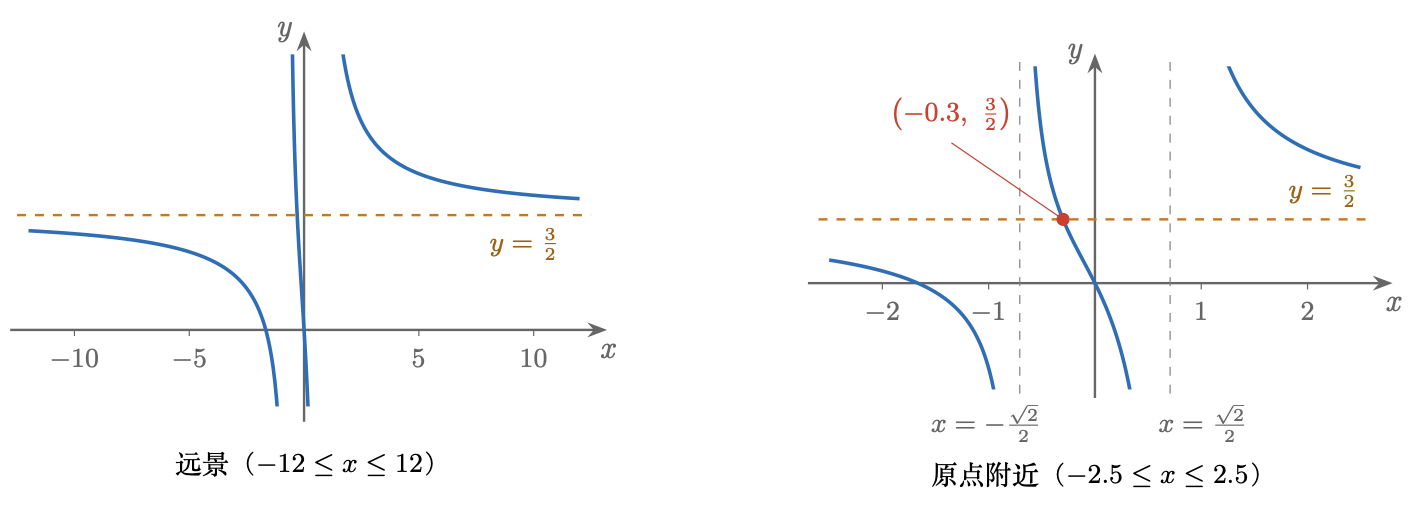
水平渐近线只描述 \(x\to\pm\infty\) 时曲线的走向,不限制中间有限范围内的图像,所以曲线可以与它相交。 判断水平渐近线只看 \(x\to\pm\infty\) 时的极限,不看曲线与这条直线有没有交点。
The Two Ends Can Differ / 两端的极限可以不同
有理函数在分子次数不高于分母时,\(x\to+\infty\) 与 \(x\to-\infty\) 的极限相同,所以上面的表格写 \(x\to\pm\infty\)。含根号的函数两端可能不同。 例如 \(\dfrac{x}{\sqrt{x^2+1}}\),先把根号写成
- \(x\to+\infty\):\(x>0\),\(|x|=x\),\(\dfrac{x}{x\sqrt{1+1/x^2}}=\dfrac{1}{\sqrt{1+1/x^2}}\to 1\);
- \(x\to-\infty\):\(x<0\),\(|x|=-x\),\(\dfrac{x}{-x\sqrt{1+1/x^2}}=\dfrac{-1}{\sqrt{1+1/x^2}}\to -1\)。
所以这个函数有两条水平渐近线:右端 \(y=1\),左端 \(y=-1\)。注意 \(x<0\) 时 \(\sqrt{x^2}=|x|=-x\),不是 \(x\)。随堂练习第 5 题就是这种情形。
- \(\displaystyle\lim_{x\to\infty}\frac{5x^3-x}{2x^3+4}\)
核对答案
\(\dfrac{5}{2}\) - \(\displaystyle\lim_{x\to\infty}\frac{x^2+1}{x+1}\)
核对答案
\(+\infty\)(分子次数高,无水平渐近线) - \(\displaystyle\lim_{x\to-\infty}\frac{7-2x}{x+4}\)
核对答案
\(-2\) - \(\displaystyle\lim_{x\to\infty}\frac{1}{x^3+1}\)
核对答案
\(0\) - (Challenge / 挑战) \(\displaystyle\lim_{x\to\infty}\frac{3x+2}{\sqrt{x^2+1}}\) and \(\displaystyle\lim_{x\to-\infty}\frac{3x+2}{\sqrt{x^2+1}}\) (Hint / 提示:\(\sqrt{x^2}=|x|\))。
核对答案
\(x\to\infty\):\(x>0\),\(\sqrt{x^2+1}=x\sqrt{1+1/x^2}\),原式 \(=\dfrac{3+2/x}{\sqrt{1+1/x^2}}\to 3\); \(x\to-\infty\):\(x<0\),\(\sqrt{x^2+1}=|x|\sqrt{1+1/x^2}=-x\sqrt{1+1/x^2}\),原式 \(=\dfrac{3+2/x}{-\sqrt{1+1/x^2}}\to -3\)
1.11连续性Continuity
直观上,连续函数的图像是一条不断开的曲线;下面用极限给出精确定义。
\(f\) is continuous at \(x=a\) if all three conditions hold:
- \(f(a)\) is defined; 函数值存在(那一点有定义);
- \(\displaystyle\lim_{x\to a} f(x)\) exists; 极限存在(左右极限都存在且相等);
- \(\displaystyle\lim_{x\to a} f(x) = f(a)\). 极限恰好等于函数值。
三个条件是递进的:先有函数值,再有极限,最后极限等于函数值。任何一条失败都叫间断。
The Three Conditions on a Graph / 三个条件与图像
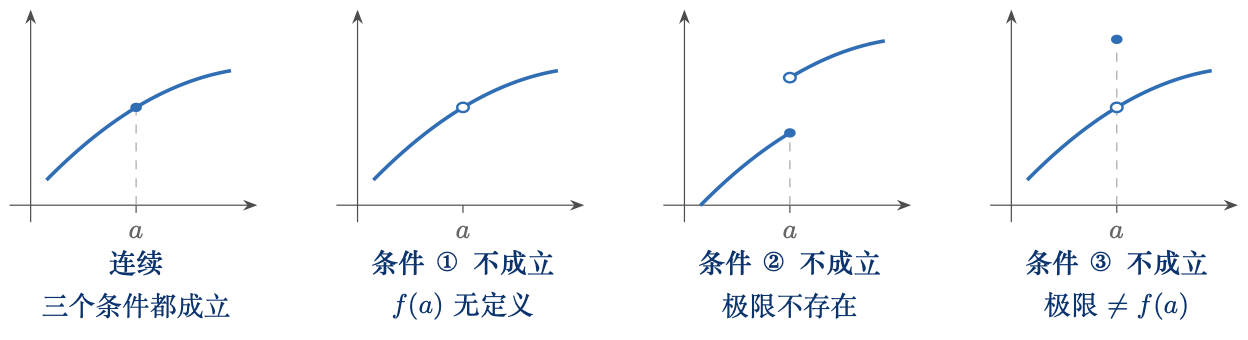
图 8 把三个条件和图像对应起来。四格图只在 \(x=a\) 这一点不同(空心圈表示这一点不在图像上,实心点表示函数值 \(f(a)\)):
- 第一格(连续):曲线经过 \(x=a\) 时没有断开,实心点 \((a,f(a))\) 正好在曲线上。
- 第二格(条件 ① 不成立):\(x=a\) 处只有空心圈,没有实心点,\(f(a)\) 无定义。两侧的曲线趋于同一高度,极限存在,但图像在这里缺了一个点。
- 第三格(条件 ② 不成立):左右两段趋于不同的高度,左右极限不相等,极限不存在。\(f(a)\) 有定义(实心点),但图像在 \(x=a\) 处断成两截。
- 第四格(条件 ③ 不成立):两侧曲线趋于空心圈的高度,极限存在;\(f(a)\) 也有定义,但实心点不在空心圈的位置,极限 \(\ne f(a)\)。
三个条件都成立,就是说图像在 \(x=a\) 处没有空缺、没有断开,函数值又正好在曲线趋近的位置上。这就是“图像不断开”的准确含义。
Continuity on an Interval / 在区间上连续
在开区间 \((a,b)\) 内每一点都连续,就称 \(f\) 在 \((a,b)\) 上连续。闭区间 \([a,b]\) 多了两个端点。 在左端点 \(a\) 处,\(x\) 只能从区间内部、也就是从右侧趋近 \(a\):区间左边的点不在考虑范围内,函数在那里甚至可能没有定义。右端点 \(b\) 同理,只能从左侧趋近。所以端点处只看单侧极限:
\(f\) is continuous on \([a,b]\) if it is continuous at every point of \((a,b)\), and
\(f\) 在 \([a,b]\) 上连续:在 \((a,b)\) 内每一点都连续,并且在左端点 \(a\) 处右极限等于函数值,在右端点 \(b\) 处左极限等于函数值。
例如 \(\sqrt{x}\) 的定义域是 \([0,\infty)\)。\(x<0\) 时 \(\sqrt{x}\) 没有定义,\(x\) 只能从右侧趋近 \(0\),所以在端点 \(x=0\) 处只检查右极限:
\(\sqrt{x}\) 在 \((0,\infty)\) 内每一点都连续,所以 \(\sqrt{x}\) 在 \([0,\infty)\) 上连续(这个区间只有左端点,只需检查这一个端点)。 1.13 节的介值定理要求函数“在 \([a,b]\) 上连续”,指的就是这个意义下的连续。
常见函数——多项式、\(\sin x\)、\(\cos x\)、\(e^x\)——在整条数轴上连续;有理函数、\(\ln x\)、\(\sqrt{x}\) 在各自定义域内连续(定义域的端点按上面的单侧意义理解)。所以判断连续性,主要是找出定义域以外的点,并检查分段函数的分段点。
Example 17 / 例题 17
Determine whether
is continuous at \(x=1\).
解 Solution
按三条件逐项检查:
① \(f(1) = 1^2 = 1\),有定义。✓
② 分段点处分左右: \(\displaystyle\lim_{x\to 1^-} f(x) = 1^2 = 1\), \(\displaystyle\lim_{x\to 1^+} f(x) = 2(1)-1 = 1\)。左右相等,极限存在且 \(=1\)。✓
③ \(\displaystyle\lim_{x\to 1} f(x) = 1 = f(1)\)。✓
答:三条件全部成立,\(f\) 在 \(x=1\) 处连续。
Example 18 / 例题 18
Is
continuous at \(x=2\)? If not, which condition fails?
解 Solution
① \(g(2) = \frac{0}{0}\) 无定义——第一条就失败了,\(g\) 在 \(x=2\) 不连续。
不过注意:
极限存在。这种只缺一个函数值的间断,下一节称为可去间断点:只要补充定义 \(g(2)=4\),函数在 \(x=2\) 处就连续了。
答:不连续;不满足条件 ① (\(g(2)\) 无定义)。
- Decide whether \(f(x)=\begin{cases} x^2+1, & x<2\\ 3x-1, & x\ge 2\end{cases}\) is continuous at \(x=2\).
判断 \(f\) 在 \(x=2\) 处是否连续。核对答案
连续(左 \(=5=\) 右 \(=f(2)\)) - At which points is \(h(x)=\dfrac{1}{x^2-9}\) discontinuous?
\(h\) 在哪些点不连续?核对答案
\(x=3\) 与 \(x=-3\) - True or False: if \(f\) is continuous at \(x=a\), then \(\displaystyle\lim_{x\to a} f(x)\) exists.
连续则极限存在,对吗?核对答案
True(连续的条件② 就是极限存在) - Which of the three continuity conditions does \(p(x)=\dfrac{x^2-16}{x-4}\) violate at \(x=4\)?
它在 \(x=4\) 处违反三条件中的哪一条?核对答案
条件① :\(p(4)\) 无定义(极限存在,\(=8\),是可去间断)
1.12间断点类型Types of Discontinuities
间断点按左右极限的情况分为三类,AP 中常见的问法是“classify the discontinuity”。
- Removable / 可去间断点:the limit exists, but the function value is missing or mismatched—a hole in the graph.
极限存在,但函数值缺失或不等于极限;图像上是一个洞。 - Jump / 跳跃间断点:both one-sided limits exist but disagree.
左右极限都存在但不相等;图像断成两截,高度跳变。 - Infinite / 无穷间断点:at least one one-sided limit is \(\pm\infty\) (a vertical asymptote).
至少一侧的单侧极限为 \(\pm\infty\);图像沿垂直渐近线无限上升或下降。
判断方法:先求左右极限。都存在且相等\(\to\)可去;都存在但不等\(\to\)跳跃;有一侧无穷\(\to\)无穷间断。
Example 19 / 例题 19
Classify all discontinuities of
解 Solution
分母 \(x^2-9=(x-3)(x+3)\) 在 \(x=3,\,-3\) 处为零,两处都是间断点。先约分:
在 \(x=-3\):约分后极限 \(\displaystyle\lim_{x\to -3}\frac{1}{x-3} = \frac{1}{-6}\) 存在,只是函数值缺失 \(\to\) 可去间断点(洞在 \((-3, -\tfrac16)\))。
在 \(x=3\):\(\dfrac{1}{x-3}\) 型,\(\frac{\text{非零}}{0}\),两侧趋于 \(\mp\infty\) \(\to\) 无穷间断点(垂直渐近线 \(x=3\))。
答:\(x=-3\) 可去;\(x=3\) 无穷。约分后分母在该点不再为零的是洞;约分后分母仍为零的是垂直渐近线。
Example 20 / 例题 20
Classify each discontinuity. / 判断下列间断点的类型。
- \(f(x)=\dfrac{1}{(x-3)^2}\) 在 \(x=3\)
核对答案
无穷间断点 - \(g(x)=\dfrac{x^2-16}{x-4}\) 在 \(x=4\)
核对答案
可去间断点(极限 \(=8\)) - \(h(x)=\begin{cases} x, & x<0\\ x+2, & x\ge 0\end{cases}\) 在 \(x=0\)
核对答案
跳跃间断点(左 \(0\),右 \(2\))
1.13介值定理Intermediate Value Theorem
连续函数有一个重要性质:在闭区间上,它取到两端函数值之间的每一个值。
If \(f\) is continuous on \([a,b]\) and \(N\) is any value between \(f(a)\) and \(f(b)\), then there exists at least one \(c\) in \((a,b)\) such that
\(f\) 在 \([a,b]\) 上连续,\(N\) 介于 \(f(a)\) 与 \(f(b)\) 之间,则 \((a,b)\) 内至少有一点 \(c\) 使 \(f(c)=N\)。
两个要点:连续是先决条件,不可省略;定理保证“至少一个”,不保证“恰好一个”。
IVT 在 AP 里最常见的用法是证明方程有根:若 \(f\) 在 \([a,b]\) 上连续,且 \(f(a)\) 与 \(f(b)\) 一正一负,则 \((a,b)\) 内至少有一个零点。
Example 21 / 例题 21
Show that
has a solution in the interval \((0,1)\).
解 Solution
设 \(f(x) = x^3+x-1\)。\(f\) 是多项式,在 \([0,1]\) 上连续(必须先写这句!)。
\(0\) 介于 \(f(0)=-1\) 与 \(f(1)=1\) 之间,由 IVT,存在 \(c\in(0,1)\) 使 \(f(c)=0\),即原方程在 \((0,1)\) 内有解。\(\blacksquare\)
AP 答题分三步:① 说明连续;② 算出两端函数值并指出目标值在两者之间;③ 引用 IVT 下结论。缺一步即扣分。
Example 22 / 例题 22(表格型)
\(f\) is continuous. Selected values are shown:
| \(x\) | \(2\) | \(5\) | \(8\) |
| \(f(x)\) | \(3\) | \(-1\) | \(4\) |
What is the minimum number of solutions of \(f(x)=0\) on \([2,8]\)?
解 Solution
在 \([2,5]\) 上:\(f\) 从 \(3\) 连续变到 \(-1\),穿过 \(0\),至少一个根。
在 \([5,8]\) 上:\(f\) 从 \(-1\) 连续变到 \(4\),再穿过 \(0\),又至少一个根。
答:至少 \(2\) 个。注意措辞:表格之外 \(f\) 还可能有更多根,IVT 只给下限——所以问的是 minimum number。
- Show that \(x^3 - 4x + 1 = 0\) has a solution in \((0,1)\).
证明该方程在 \((0,1)\) 内有解。核对答案
\(f(x)=x^3-4x+1\) 是多项式,在 \([0,1]\) 上连续;\(f(0)=1>0\),\(f(1)=-2<0\),\(0\) 介于两者之间, 由 IVT,存在 \(c\in(0,1)\) 使 \(f(c)=0\),即方程在 \((0,1)\) 内有解 - \(g\) is continuous with \(g(1)=4\), \(g(3)=10\). Must there be a \(c\) in \((1,3)\) with \(g(c)=7\)?
\((1,3)\) 内是否一定存在 \(c\) 使 \(g(c)=7\)?核对答案
一定有(\(7\) 介于 \(4\) 与 \(10\) 之间,\(g\) 连续,IVT) - Can the IVT guarantee that \(f(x)=\dfrac{1}{x}\) takes the value \(0\) on \([-1,1]\)? Why?
能否用 IVT 断言它在 \([-1,1]\) 上取到 \(0\)?为什么?核对答案
不能:\(f\) 在 \(x=0\) 处不连续,IVT 前提不满足(事实上 \(\frac1x\) 从不为 \(0\))
1.14AP 高频题型AP-Style Problems
Example 23: Finding a Parameter / 求参数使函数连续
Find the value of \(a\) that makes
continuous at \(x=2\).
解 Solution
连续 \(\iff\) 分段点处左极限 \(=\) 右极限 \(=\) 函数值:
令 \(2a+3 = 5\),解得
答:\(a=1\)。这类题的解法:把“连续”的条件写成方程。
Example 24: Holes vs. Asymptotes / 洞与渐近线
How many vertical asymptotes and how many holes does the graph of
have? Find the horizontal asymptote as well.
解 Solution
分解:
\(x=1\):因式 \((x-1)\) 约掉了 \(\to\) 洞。洞的高度:约分后 \(\dfrac{2(x+1)}{x-2}\) 在 \(x=1\) 取值 \(\dfrac{4}{-1} = -4\),洞在 \((1,-4)\)。
\(x=2\):约不掉 \(\to\) 垂直渐近线 \(x=2\)。
水平渐近线:分子分母同为二次,取最高次系数比 \(\dfrac{2}{1}\),即 \(y=2\)。
答:1 条垂直渐近线(\(x=2\))、1 个洞(\((1,-4)\))、水平渐近线 \(y=2\)。
Example 25: Reasoning from a Table / 表格推理单侧极限
The table gives values of a function \(f\):
| \(x\) | \(1.9\) | \(1.99\) | \(2.01\) | \(2.1\) |
| \(f(x)\) | \(4.8\) | \(4.98\) | \(7.02\) | \(7.2\) |
Which statement is best supported by the table?
(A) \(\displaystyle\lim_{x\to 2} f(x) = 5\) (B) \(\displaystyle\lim_{x\to 2} f(x) = 7\) (C) \(\displaystyle\lim_{x\to 2} f(x) = 6\) (D) \(\displaystyle\lim_{x\to 2} f(x)\) does not exist
解 Solution
从左侧(\(1.9,\,1.99\)):\(f\) 趋向 \(5\);从右侧(\(2.01,\,2.1\)):\(f\) 趋向 \(7\)。 左右极限看起来不相等,极限不存在。
答:(D)。干扰项 (C) 的 \(6\) 是 \(5\) 和 \(7\) 的平均值;左右极限不相等时极限不存在,不能取平均。
- Find \(k\) so that \(f(x)=\begin{cases} kx^2, & x\le 2\\ 3x+2, & x>2\end{cases}\) is continuous at \(x=2\).
求使 \(f\) 在 \(x=2\) 连续的 \(k\)。核对答案
\(4k=8\),\(k=2\) - How many vertical asymptotes and holes does \(f(x)=\dfrac{3x^2-3}{x^2-1}\) have? What is its horizontal asymptote?
求垂直渐近线与洞的个数,以及水平渐近线。核对答案
\(f=\dfrac{3(x-1)(x+1)}{(x-1)(x+1)}\):0 条垂直渐近线、2 个洞(\(x=\pm1\),高度均为 \(3\))、水平渐近线 \(y=3\)
1.15章末练习Chapter Exercises
Part A: True or False / 概念判断
- If \(\displaystyle\lim_{x\to a}f(x)\) exists, then \(f(a)\) must be defined.
极限存在则函数值必有定义,对吗?核对答案
False(如 \(\frac{x^2-1}{x-1}\) 在 \(x=1\) 无定义,极限却是 \(2\)) - If \(f\) is continuous at \(x=a\), then \(\displaystyle\lim_{x\to a}f(x) = f(a)\).
连续则极限等于函数值,对吗?核对答案
True(连续定义第 3 条) - If both one-sided limits exist, then \(\displaystyle\lim_{x\to a}f(x)\) exists.
左右极限都存在则整体极限存在,对吗?核对答案
False(还须相等) - A zero of the denominator is always a vertical asymptote.
分母为零的点一定是垂直渐近线,对吗?核对答案
False(可能是洞) - If \(f\) is continuous on \([1,3]\) and \(f(1)\,f(3)<0\), then \(f\) has a zero in \((1,3)\).
连续且两端异号则必有零点,对吗?核对答案
True(IVT)
Part B: Evaluating Limits / 代数求极限
Evaluate. / 计算下列极限。
- \(\displaystyle\lim_{x\to 3}\frac{x^2+2x-15}{x-3}\)
核对答案
\(8\)(\((x+5)(x-3)\)) - \(\displaystyle\lim_{x\to 0}\frac{\sqrt{x+16}-4}{x}\)
核对答案
\(\dfrac{1}{8}\) - \(\displaystyle\lim_{x\to 2}\frac{x^3-8}{x^2-4}\)
核对答案
\(3\)(\(\frac{(x-2)(x^2+2x+4)}{(x-2)(x+2)}\to\frac{12}{4}\)) - \(\displaystyle\lim_{x\to \infty}\frac{4x^2-x}{2x^2+3}\)
核对答案
\(2\) - \(\displaystyle\lim_{x\to 0}\ x^2\sin\!\frac{5}{x}\)
核对答案
\(0\)(夹逼) - \(\displaystyle\lim_{x\to 1}\frac{\dfrac{1}{x}-1}{x-1}\)
核对答案
\(-1\)(\(\frac{(1-x)/x}{x-1}=-\frac1x\to -1\))
Part C: One-Sided Limits and Existence / 单侧极限与存在性
- For \(f(x)=\dfrac{|x-2|}{x-2}\), find both one-sided limits at \(x=2\) and decide whether the limit exists.
求两个单侧极限,并判断整体极限。核对答案
左 \(-1\)、右 \(1\);极限不存在 - \(f(x)=\begin{cases} 3x-1, & x<1\\ x^2+1, & x\ge 1\end{cases}\):Is \(f\) continuous at \(x=1\)? / 判断 \(f\) 在 \(x=1\) 是否连续。
核对答案
连续(左 \(2=\) 右 \(2=f(1)\)) - \(f(x)=\begin{cases} x+4, & x<0\\ x^2, & x\ge 0\end{cases}\):Does \(\displaystyle\lim_{x\to 0}f(x)\) exist? If so find it, and classify the discontinuity.
判断极限是否存在并求值;指出间断点类型。核对答案
不存在(左 \(4\)、右 \(0\));跳跃间断点 - \(g(x)=\dfrac{1}{x-4}\):find \(\displaystyle\lim_{x\to 4^+}g(x)\) and \(\displaystyle\lim_{x\to 4^-}g(x)\).
求这两个单侧极限。核对答案
\(+\infty\);\(-\infty\)
Part D: Asymptotes and Continuity / 渐近线与连续
- Find all holes, vertical asymptotes, and the horizontal asymptote of \(f(x)=\dfrac{x^2-9}{x^2-5x+6}\).
求它的所有洞、垂直渐近线与水平渐近线。核对答案
洞 \((3,6)\);垂直渐近线 \(x=2\);水平渐近线 \(y=1\) - On what interval is \(f(x)=\sqrt{x-1}\) continuous?
它在哪个区间上连续?核对答案
\([1,\infty)\) - Classify every discontinuity of \(f(x)=\dfrac{x+2}{x^2+x-2}\).
给它的每个间断点分类。核对答案
\(f(x)=\dfrac{x+2}{(x+2)(x-1)}\):\(x=-2\) 可去(洞,极限 \(-\frac13\))、\(x=1\) 无穷 - Find \(a\) so that \(f(x)=\begin{cases} x^2-a, & x<3\\ 4x+2, & x\ge 3\end{cases}\) is continuous at \(x=3\).
求使 \(f\) 在 \(x=3\) 连续的 \(a\)。核对答案
\(9-a=14\),\(a=-5\) - Find the horizontal and vertical asymptotes of \(f(x)=\dfrac{5-3x^2}{x^2+2}\).
求它的水平渐近线与垂直渐近线。核对答案
水平 \(y=-3\);无垂直渐近线(\(x^2+2\) 恒正)
Part E: AP-Style / AP 风格综合
- \(\displaystyle\lim_{x\to\infty}\frac{\sqrt{9x^2+x}}{2x+1} = \) ?
核对答案
\(\dfrac{3}{2}\)(\(x>0\) 时分子分母同除以 \(x\):\(\dfrac{\sqrt{9+1/x}}{2+1/x}\to\dfrac32\)) - \(f\) is continuous with \(f(0)=2\), \(f(2)=-3\), \(f(4)=1\). What is the minimum number of solutions of \(f(x)=0\) in \((0,4)\)?
\(f(x)=0\) 在 \((0,4)\) 内至少有几个解?核对答案
至少 \(2\) 个(\([0,2]\) 与 \([2,4]\) 各变号一次) - \(f(x)=\begin{cases} \dfrac{x^2-1}{x-1}, & x\ne 1\\[6pt] k, & x=1\end{cases}\): Find the \(k\) that makes \(f\) continuous at \(x=1\). / 求使 \(f\) 在 \(x=1\) 连续的 \(k\)。
核对答案
\(k=2\) - Given \(\displaystyle\lim_{x\to 2^-}f(x) = 3\), \(\displaystyle\lim_{x\to 2^+}f(x) = 3\), and \(f(2)=1\), which are true: ① the limit exists; ② \(f\) is continuous at \(2\); ③ \(x=2\) is a removable discontinuity?
三个说法哪些为真?核对答案
① 真(左右极限都是 \(3\))、② 假(\(\lim=3\ne f(2)=1\))、③ 真(极限存在但不等于函数值,是可去间断点) - A particle has position \(s(t)=t^2\) meters, where \(t\) is in seconds. Write the average velocity on \([2,\,2+h]\), simplify, find the limit as \(h\to 0\), and interpret it.
写出平均速度表达式,化简求 \(h\to0\) 的极限,并解释其物理意义。核对答案
平均速度 \(\dfrac{(2+h)^2-4}{h} = \dfrac{4h+h^2}{h} = 4+h\ (h\ne0)\),\(h\to 0\) 时极限为 \(4\)。 含义:质点在 \(t=2\) 秒时的瞬时速度为 \(4\) 米/秒。这就是第二章要学的导数。
1.16本章小结Unit Summary
Key Ideas / 核心知识
- 极限描述趋势:\(\displaystyle\lim_{x\to a}f(x)\) 与 \(f(a)\) 是两回事。
- 极限存在 \(\iff\) 左右极限存在且相等。
- 求极限先代入:函数在该点连续时,代入值就是极限;得 \(\frac{0}{0}\) 则因式分解 / 有理化 / 通分后再代入。
- 夹逼定理处理“有界函数 \(\times\) 趋于 \(0\) 的函数”型极限;\(\displaystyle\lim_{x\to 0}\frac{\sin x}{x}=1\)。
- \(\frac{\text{非零}}{0}\) \(\to\) 无穷极限与垂直渐近线(先分单侧定符号); \(x\to\pm\infty\) 比次数定水平渐近线。
- 连续三条件:有定义、有极限、二者相等;间断分可去、跳跃、无穷三类。
- IVT:连续函数在闭区间上取遍两端之间的所有值;证明有根分三步:连续、变号、引用定理。