


4.1单元总览Unit Overview
What Do We Learn in Unit 4? / 第四单元学什么?
第二、三章学习了求导的方法,本章学习导数在四个方面的应用:
- Motion: not just velocity, but speed, and speeding up vs. slowing down. 运动分析:不只求速度,还要判断加速还是减速。
- Related rates: when two changing quantities are linked by an equation. 相关变化率:两个随时间变化的量由一个方程联系起来。
- Linearization: using the tangent line to approximate values. 线性近似:用切线代替曲线做估算。
- L'Hospital's Rule: using derivatives to evaluate \(\frac{0}{0}\) limits. 洛必达法则:用导数求未定式极限。
Learning Objectives / 学习目标
学完本章后,你应该能够:
- Analyze straight-line motion: velocity, speed, acceleration, direction.
完整分析直线运动:速度、速率、加速度与方向。 - Determine when a particle is speeding up or slowing down.
判断质点加速还是减速。 - Interpret derivatives in context with correct units.
在情境中带单位解释导数。 - Set up and solve related-rates problems.
建立并求解相关变化率问题。 - Use linearization and differentials to approximate.
用线性近似与微分做估算。 - Apply L'Hospital's Rule to indeterminate limits.
对未定式极限使用洛必达法则。
4.2运动进阶:速率与加减速Motion Revisited: Speed
第二章建立了 \(s\to v\to a\) 的关系,本节补充速率(speed)的概念。“越来越快”指速率变大,而不是速度变大;速度为负时,两者的变化方向相反。
Speed is the absolute value of velocity—how fast, not which way.
速率是速度的绝对值——只表示快慢,不表示方向。
The particle is speeding up \(\iff\) \(v\) and \(a\) have the same sign; slowing down \(\iff\) opposite signs.
加速\(\iff\) \(v\) 与 \(a\) 同号;减速\(\iff\) 异号。
直观理解:\(a\) 与 \(v\) 同向时,速率增大;反向时,速率减小。 只看 \(a\) 的正负判断加减速是最常见的错误——例如 \(v<0\), \(a<0\) 时,质点在加速。
Example 1 / 例题 1(完整运动分析)
A particle moves with position
Find when the particle is moving right, moving left, speeding up, and slowing down.
解 Solution
把 \(v\)、\(a\) 的符号标在同一条数轴上:
方向(看 \(v\)):向右 \((0,1)\cup(3,5)\);向左 \((1,3)\)。
加减速(看同异号):
答:向右 \((0,1)\cup(3,5)\);向左 \((1,3)\);加速 \((1,2)\cup(3,5)\);减速 \((0,1)\cup(2,3)\)。
Example 2 / 例题 2(快速判断)
At \(t=2\), a particle has \(v(2)=-4\) m/s and \(a(2)=-1\) m/s\(^2\). Find its speed, and determine whether it is speeding up or slowing down.
解 Solution
速率 \(=|-4| = 4\) m/s。\(v\) 与 \(a\) 同为负——同号,加速。
答:速率 4 m/s,正在加速。质点向左运动(\(v<0\)),加速度也指向左(\(a<0\)),所以速率增大。
- For \(s(t)=t^2-6t\) (m, s): at \(t=1\) find the velocity, speed, direction of motion, and whether the particle is speeding up or slowing down.
求 \(t=1\) 时的速度、速率、方向,并判断加速还是减速。核对答案
\(v(1)=-4\) m/s(向左),速率 \(4\) m/s;\(a(1)=2\) m/s\(^2\),与 \(v\) 异号,所以减速 - Given \(v(3)=5\) and \(a(3)=-2\): speeding up or slowing down?
加速还是减速?核对答案
异号(\(5>0,-2<0\)),减速 - True or False: if \(a(t)>0\), the particle must be speeding up.
\(a>0\) 一定在加速,对吗?核对答案
False(\(v<0\) 且 \(a>0\) 时是减速;须看同异号)
4.3情境中的变化率Rates in Context
The derivative measures rates far beyond motion—water volume, population, temperature, cost. AP asks for two things: the units and the sentence. Template: “At (time) \(a\), the (quantity) is increasing/decreasing at a rate of \(|f'(a)|\) (units).”
导数作为变化率,应用不限于运动。AP 考两件事:单位和句子 (沿用 2.6 节的三要素句式:时刻、速率带单位、方向)。
Example 3 / 例题 3
Rainwater collects in a tank. \(R(t)\) is the total amount of water (liters) \(t\) hours after midnight. What are the units and meaning of \(R'(t)\)? If \(R'(3)=12\) and \(R'\) is decreasing near \(t=3\), what is happening at 3 a.m.?
解 Solution
\(R'(t)\) 的单位是 \(\dfrac{\text{升}}{\text{小时}}\),含义是进水的速率。
\(R'(3)=12\):凌晨 3 点,水正以每小时 12 升的速率流入水箱。
\(R'\) 在减小:进水速率在放缓——雨势渐弱。注意,水量 \(R\) 本身仍在增加 (\(R'>0\)),只是增加得越来越慢。“量在增,率在减”并不矛盾,这层区分是第五章凹凸性的预告。
The Second Derivative in Context / 二阶导数在情境中的含义
例题 3 中“\(R'\) 在 \(t=3\) 附近减小”,用二阶导数写就是 \(R''(3)<0\)。\(R''(t)\) 是 \(R'(t)\) 的导数,含义是进水速率本身的变化率。它的单位是 \(R'\) 的单位再除以时间的单位:
例如,若 \(R''(3)=-4\),含义是:凌晨 3 点时,进水速率正以每小时 \(4\) 升/小时的速率减小。
\(f'\) 和 \(f''\) 回答的是两个不同的问题:\(f'\) 的正负说明量 \(f\) 在增加还是减少;\(f''\) 的正负说明变化率 \(f'\) 本身在增大还是减小。两者合起来,就能说出量的增减是在变快还是变慢:
| \(f'\) | \(f''\) | 量 \(f\) 的变化 |
| \(+\) | \(+\) | 增加,且增加得越来越快 |
| \(+\) | \(-\) | 增加,但增加得越来越慢(例题 3) |
| \(-\) | \(-\) | 减少,且减少得越来越快 |
| \(-\) | \(+\) | 减少,但减少得越来越慢 |
规律是:\(f'\) 与 \(f''\) 同号时,\(|f'|\) 增大,增减在变快;异号时,\(|f'|\) 减小,增减在变慢。这与 4.2 节用 \(v\)、\(a\) 同号或异号判断加速、减速是同一个规律(\(v=s'\),\(a=s''\),速率 \(|v|\) 就是 \(|s'|\))。
- \(C(x)\) is the total cost (yuan) of producing \(x\) items. Give the units and meaning of \(C'(100)=35\).
说出 \(C'(100)=35\) 的单位和含义。核对答案
元/件;生产第 100 件附近时,每多生产一件成本约增加 35 元(边际成本) - \(T(t)\) is an oven's temperature (\(^\circ\)C) after \(t\) minutes. Given \(T'(5)=20\) and \(T''(5)<0\), describe in everyday language what is happening at \(t=5\).
用日常语言描述第 5 分钟时烤箱在发生什么。核对答案
温度正以 20 \(^\circ\)C/min 的速率上升,但上升的速率正在放缓(仍在升温,升得变慢了)
4.4相关变化率:方法Related Rates: The Method
第三章的吹气球问题已经说明:变化率会沿着复合关系传递。相关变化率问题是这类问题的一般形式——两个量由一个方程联系,都随时间变化;已知其中一个的变化率,求另一个。
- Draw and label: sketch, name the variables, mark the known and wanted rates.
画图设变量,标出已知的和要求的变化率。 - Relate: write an equation linking the variables (geometry, Pythagoras, similar triangles …).
写出连接各变量的方程。 - Differentiate with respect to \(t\)—every changing quantity carries a Chain-Rule factor: \(\frac{d}{dt}[r^2] = 2r\frac{dr}{dt}\).
两边对 \(t\) 求导(每个变化的量都要用链式法则)。 - Only now substitute the numbers and solve for the wanted rate.
这时才代入数值,解出所求变化率。 - Answer with units. / 带单位作答。
原则:先求导,再代入数值。变化的量若在求导前就代成数字,它的变化率会被当成零,结果必然出错。
Why Step 3 Uses the Chain Rule / 第三步为什么要用链式法则
相关变化率问题中的量(半径 \(r\)、体积 \(V\)、距离 \(x\)、\(y\) 等)都随时间变化,每一个都是时间 \(t\) 的函数,例如 \(r=r(t)\)。题目给出的和要求的变化率,就是这些函数对 \(t\) 的导数 \(\dfrac{dr}{dt}\)、\(\dfrac{dV}{dt}\) 等。 因此 \(r^2\) 是复合函数:外层 \(u^2\),内层 \(u=r(t)\)。由链式法则,
这与第三章 3.7 节隐函数求导的 \(\dfrac{d}{dx}\bigl[y^2\bigr]=2y\cdot\dfrac{dy}{dx}\) 是同一个式子:那里 \(y\) 是 \(x\) 的函数,对 \(x\) 求导;这里 \(r\) 是 \(t\) 的函数,对 \(t\) 求导。 方程中每个随时间变化的量,求导后都带上自己的变化率,于是已知的变化率和要求的变化率出现在同一个方程里,可以解出要求的那一个。不随时间变化的量(如梯子的长度)是常数,导数为 \(0\)。
Signs of the Rates / 变化率的正负号
\(\dfrac{dx}{dt}\) 是 \(x\) 每单位时间的变化量:\(x\) 增加时它是正数,\(x\) 减少时它是负数。题目通常只说变化有多快(一个正数),要根据这个量在增加还是减少写上正负号。例如:
- “水以 \(2\) m\(^3\)/min 的速率从水箱流出”:水的体积 \(V\) 在减少,写成 \(\dfrac{dV}{dt}=-2\);
- “梯脚以 \(1\) ft/s 的速率滑离墙”:梯脚到墙的距离 \(x\) 在增加,写成 \(\dfrac{dx}{dt}=1\)。
反过来,解出的变化率是负数,说明这个量在减少(例题 5 中的 \(\dfrac{dy}{dt}=-\dfrac34\))。
Example 4 / 例题 4(气球问题)
Air is pumped into a spherical balloon at a rate of \(100\) cm\(^3\)/s. How fast is the radius increasing when the radius is \(5\) cm?
解 Solution
已知 \(\dfrac{dV}{dt}=100\),求 \(r=5\) 时的 \(\dfrac{dr}{dt}\)。
方程:\(V = \dfrac43\pi r^3\)。
对 \(t\) 求导:
代入(求导之后才代入)\(\dfrac{dV}{dt}=100\),\(r=5\):
答:\(\dfrac{1}{\pi}\) cm/s。第三章图 1 的“链条”现在读作: \(\frac{dV}{dt}\) 已知、\(\frac{dV}{dr}=4\pi r^2\) 已知,反解 \(\frac{dr}{dt}\)。
Example 5 / 例题 5(梯子问题)
A 10-ft ladder leans against a wall. The bottom slides away from the wall at \(1\) ft/s. How fast is the top sliding down when the bottom is \(6\) ft from the wall?
解 Solution
设梯脚离墙 \(x\)、梯顶离地 \(y\):
方程:\(x^2+y^2 = 100\)(勾股)。
对 \(t\) 求导:
代入:\(x=6\) 时 \(y = \sqrt{100-36} = 8\);\(\dfrac{dx}{dt}=1\):
答:梯顶以 \(\dfrac34\) ft/s 的速率下滑(负号表示 \(y\) 在减小;作答时写“下滑速率 \(\frac34\)”)。 注意:常数 \(10\) 从一开始就可以用,但 \(x=6,\ y=8\) 必须在求导之后才能代入。
Why Substitute Only After Differentiating / 为什么先求导、后代入
梯子滑动时,\(x\)、\(y\) 都随时间变化:\(x=x(t)\),\(y=y(t)\)。梯子长度不变,所以方程
在每一个时刻都成立,可以两边对 \(t\) 求导,得到例题 5 中的求导式。而 \(x=6\) 只在某一个时刻成立。
如果先代入 \(x=6\),方程变成 \(36+y^2=100\),解出 \(y=8\):\(y\) 成了常数,对 \(t\) 求导只能得到
即梯顶不动。这个结果显然不对:梯脚在滑离墙,梯顶一定在下滑。 错误在于 \(36+y^2=100\) 只在 \(x=6\) 的那一个时刻成立,前后的时刻 \(x\ne6\),它就不成立了,所以不能对它求导。 这和第二章求导数时的情形相同:\(f(x)=x^2\) 在 \(x=3\) 处 \(f(3)=9\),对常数 \(9\) 求导得 \(0\),但 \(f'(3)=6\)。导数描述的是附近的变化,要先对一般的 \(x\) 求出导数,再代入具体的值。
- A square's side grows at \(3\) cm/s. How fast is the area changing when the side is \(10\) cm?
边长 \(10\) cm 时面积变化多快?核对答案
\(\dfrac{dA}{dt} = 2s\,\dfrac{ds}{dt} = 2(10)(3) = 60\) cm\(^2\)/s - A circle's radius grows at \(2\) cm/s. How fast is the area changing when \(r=4\)?
\(r=4\) 时面积变化多快?核对答案
\(\dfrac{dA}{dt} = 2\pi r\,\dfrac{dr}{dt} = 16\pi\) cm\(^2\)/s - A cube's edge grows at \(2\) cm/s. How fast is the volume changing when the edge is \(3\) cm?
棱长 \(3\) cm 时体积变化多快?核对答案
设棱长为 \(s\):\(\dfrac{dV}{dt} = 3s^2\,\dfrac{ds}{dt} = 3(9)(2) = 54\) cm\(^3\)/s
4.5相关变化率:经典模型Related Rates: Classic Setups
AP 的相关变化率题主要用到三类关系:勾股定理(梯子、两车远离)、相似三角形(圆锥水箱、影子)、几何量公式(面积体积)。
Similar Triangles in a Cone / 圆锥水箱中的相似三角形
倒立的圆锥水箱(尖端朝下)里的水,也是一个倒立的圆锥。设水箱高 \(H\)、顶部半径 \(R\),这两个数由水箱决定,不变;某一时刻水深 \(h\)、水面半径 \(r\),这两个量随注水而变。 沿中轴把水箱竖直切开,得到图 1 的截面。
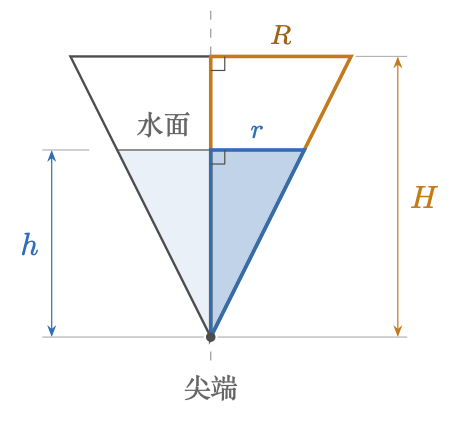
图中有两个直角三角形,直角都在中轴上:小三角形由尖端、水面中心、水面边缘组成,竖直边 \(h\)、水平边 \(r\);大三角形由尖端、顶面中心、顶面边缘组成,竖直边 \(H\)、水平边 \(R\)。 两个三角形在尖端处的角是同一个角,又都有一个直角,所以相似,对应边成比例:
\(\dfrac RH\) 是常数,所以不论水深多少,水面半径与水深之比都不变。例如水箱高 \(10\) m、顶部半径 \(4\) m,则 \(r=\dfrac{4}{10}h=\dfrac25h\)。如果题目给的是顶部直径,要先除以 \(2\) 得到 \(R\)。
用这个关系把 \(r\) 换成 \(h\),水的体积就只含一个变量:
如果不消去 \(r\),\(V=\frac13\pi r^2h\) 中 \(r\) 和 \(h\) 都在变,求导后会同时出现 \(\dfrac{dr}{dt}\) 和 \(\dfrac{dh}{dt}\) 两个未知的变化率,仍然要用 \(r\) 与 \(h\) 的关系才能解出 \(\dfrac{dh}{dt}\),所以先消去 \(r\) 更简便。
Example 6 / 例题 6(圆锥水箱)
Water pours into an inverted cone-shaped tank at \(2\) m\(^3\)/min. The tank's radius is always half its height (\(r = h/2\) at every water level). How fast is the water level rising when the water is \(4\) m deep?
解 Solution
题中的 \(r=\dfrac h2\) 就是图 1 中 \(\dfrac RH=\dfrac12\) 的情形,即水箱顶部半径是高的一半。 有 \(r,h\) 两个变量,先用几何关系消去一个。由 \(r=\dfrac h2\):
对 \(t\) 求导:
代入 \(\dfrac{dV}{dt}=2\),\(h=4\):
答:\(\dfrac{1}{2\pi}\) m/min。圆锥水箱题的方法:用 \(r\)-\(h\) 关系把 \(V\) 写成只含 \(h\) 的函数,再求导。
Example 7 / 例题 7(两车远离)
Two cars leave the same intersection at the same time, one going north at \(60\) km/h and one going east at \(80\) km/h. How fast is the distance between them increasing one hour later?
解 Solution
设北向距离 \(y\)、东向 \(x\)、两车距离 \(z\):\(z^2 = x^2 + y^2\)。
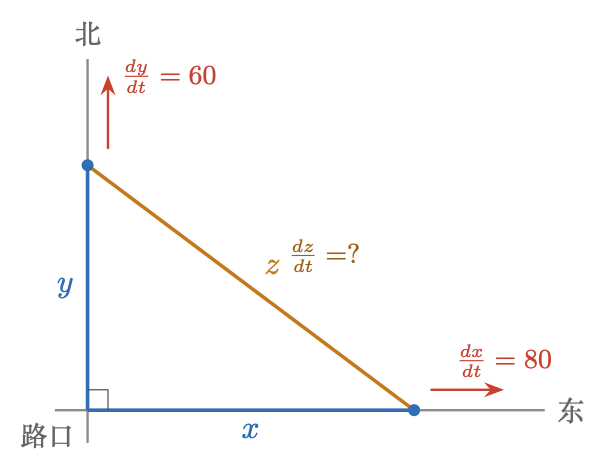
例题 5 中梯子长 \(10\) ft 不变,三角形只有两条直角边在变;这里两车都在离开路口,两条直角边 \(x\)、\(y\) 和斜边 \(z\) 都随时间变化(图 2),所以 \(z^2\) 求导时也要乘 \(\dfrac{dz}{dt}\)。
对 \(t\) 求导:
一小时后 \(x=80\),\(y=60\),\(z = \sqrt{80^2+60^2} = 100\):
答:\(100\) km/h。
Shadow Problems / 影子问题
影子问题也用相似三角形。下面完整做一道,并分清两个不同的变化率:影长的变化率和影子顶端的速度。
路灯高 \(4.5\) m,身高 \(1.5\) m 的人以 \(1\) m/s 的速度沿直线走离路灯。人离灯柱 \(6\) m 时:(1) 影长增加多快?(2) 影子顶端移动多快?
第一步(画图、设变量):设人到灯柱底部的距离为 \(x\),影长(人脚到影子顶端的距离)为 \(s\),则影子顶端到灯柱底部的距离是 \(x+s\)(图 3)。人在走远,\(x\) 增大,所以 \(\dfrac{dx}{dt}=1\)。
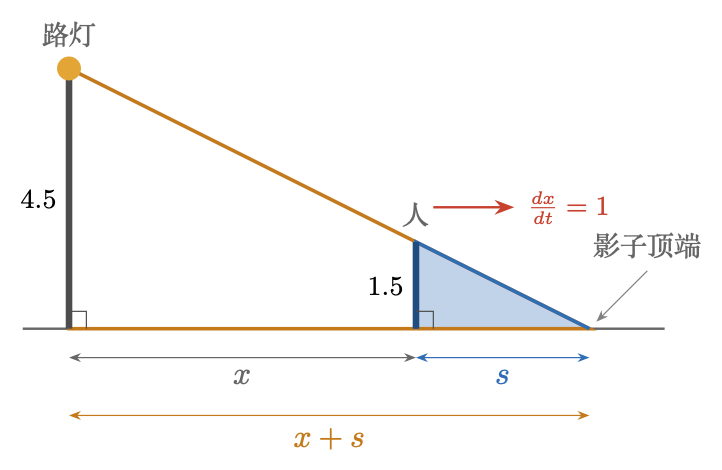
第二步(用相似三角形列方程):图 3 中有两个直角三角形,直角都在地面上:小三角形由人和影子组成,竖直边 \(1.5\)、水平边 \(s\);大三角形由灯柱和地面组成,竖直边 \(4.5\)、水平边 \(x+s\)。 两者在影子顶端处的角是同一个角,所以相似:
两边乘 \(4.5\),得 \(3s=x+s\),即
第三步(对 \(t\) 求导,求影长的变化率):
结果中没有 \(x\):不论人离灯柱多远,影长都以 \(0.5\) m/s 增加,题中的“离灯柱 \(6\) m”不影响答案。
第四步(求影子顶端的速度):影子顶端的位置用它到灯柱底部(一个固定点)的距离 \(x+s\) 表示,所以它的速度是
这里不能只算 \(\dfrac{ds}{dt}\)。\(s\) 是影子顶端到人的距离,而人本身也在以 \(1\) m/s 前进;\(\dfrac{ds}{dt}\) 只是影子顶端比人多走的那一部分。求一个点移动的速度,要用它到固定点的距离对 \(t\) 求导。
答:(1) 影长以 \(0.5\) m/s 的速率增加;(2) 影子顶端以 \(1.5\) m/s 的速度离开路灯。读题时要看清问的是影长还是影子顶端。
- A spherical balloon inflates at \(200\) cm\(^3\)/s. How fast is \(r\) growing when \(r=10\)?
\(r=10\) 时半径增长多快?核对答案
\(200 = 4\pi(100)\,\dfrac{dr}{dt} \Rightarrow \dfrac{dr}{dt} = \dfrac{1}{2\pi}\) cm/s - A 13-ft ladder leans on a wall; its base slides away at \(2\) ft/s. How fast is the top sliding down when the base is \(5\) ft out?
梯脚离墙 \(5\) ft 时梯顶下滑多快?核对答案
\(x=5,\ y=12\),\(\dfrac{dx}{dt}=2\):\(5(2)+12\,\dfrac{dy}{dt}=0 \Rightarrow \dfrac{dy}{dt} = -\dfrac{5}{6}\) ft/s(下滑 \(\dfrac56\) ft/s) - An inverted cone tank has \(r = \dfrac h3\); water enters at \(3\) m\(^3\)/min. How fast is the level rising when \(h=3\) m?
水深 \(3\) m 时水位上升多快?核对答案
\(V = \dfrac{\pi}{27}h^3\),\(\dfrac{dV}{dt} = \dfrac{\pi}{9}h^2\,\dfrac{dh}{dt}\): \(3 = \pi\,\dfrac{dh}{dt} \Rightarrow \dfrac{dh}{dt} = \dfrac{3}{\pi}\) m/min - (Challenge: shadow / 挑战·影子问题) A street lamp is \(5\) m tall; a \(2\)-m person walks away at \(1.2\) m/s. How fast does the tip of the shadow move?
(提示:设人离灯 \(x\)、影长 \(s\),相似三角形 \(\frac{s}{2}=\frac{x+s}{5}\),先解出 \(s\) 与 \(x\) 的关系。)核对答案
\(5s = 2(x+s) \Rightarrow s = \dfrac{2}{3}x \Rightarrow \dfrac{ds}{dt} = \dfrac23(1.2) = 0.8\); 尖端速度 \(= \dfrac{dx}{dt}+\dfrac{ds}{dt} = 1.2+0.8 = 2\) m/s
4.6线性近似Linearization
在切点附近,切线和曲线几乎重合,所以可以用切线(一次函数,容易计算)来近似曲线(难以计算)。这种近似方法叫做线性近似(linearization):
The linearization of \(f\) at \(x=a\) is
It is exactly the tangent line at \(x=a\). For \(x\) near \(a\),
它就是 \(x=a\) 处的切线方程。当 \(x\) 靠近 \(a\) 时,
Usage: to estimate a hard-to-compute \(f(x)\), pick a convenient point \(a\) nearby and use \(L\) instead of \(f\).
用法:要估计难以直接计算的 \(f(x)\),就在附近取一个便于计算的点 \(a\),用 \(L\) 代替 \(f\)。
Overestimate or Underestimate? / 估计值偏大还是偏小
图 4 中,切线 \(L\) 在曲线 \(y=\sqrt x\) 的上方,所以用 \(L\) 算出的值比真值大,例如 \(L(9.6)=3.1\),而 \(\sqrt{9.6}=3.0983\ldots\)。切线在曲线上方还是下方,由曲线弯曲的方向决定:
- 曲线开口向下(下凹,如 \(\sqrt x\)、\(\ln x\))时,切线在曲线上方,\(L(x)\ge f(x)\),估计值偏大;
- 曲线开口向上(上凹,如 \(x^2\)、\(e^x\))时,切线在曲线下方,\(L(x)\le f(x)\),估计值偏小。例如 \(e^x\) 在 \(a=0\) 处的线性近似是 \(L(x)=1+x\),\(L(0.1)=1.1\),而 \(e^{0.1}=1.1051\ldots\),估计值偏小。
第五章 5.6 节会学到:\(f''<0\) 时曲线下凹,\(f''>0\) 时曲线上凹。所以知道 \(f''\) 在切点附近的正负,就能判断线性近似偏大还是偏小。AP 题常在估算之后问估计值偏大还是偏小,回答时要写出理由(曲线的凹凸或 \(f''\) 的正负)。
Example 8 / 例题 8
Use a linearization to approximate
解 Solution
\(9.2\) 附近便于计算的点是 \(a=9\)。设 \(f(x)=\sqrt x\):
答:\(\sqrt{9.2}\approx 3.033\)(真值 \(3.0331\ldots\),前三位小数全对)。 \(L(9.2)=3.0333\ldots\) 比真值大,估计值偏大,因为 \(f''(x)=-\dfrac{1}{4x^{3/2}}<0\),\(\sqrt x\) 的图像下凹,切线在曲线上方。
Example 9 / 例题 9
Use a linearization at \(a=1\) to approximate \(\ln(1.05)\).
解 Solution
\(f(x)=\ln x\):\(f(1)=0\),\(f'(x)=\frac1x\),\(f'(1)=1\):
答:\(\approx 0.05\)(真值 \(0.04879\ldots\))。这也是物理里常用的近似 \(\ln(1+u)\approx u\)(\(u\) 很小时)的出处。 估计值 \(0.05\) 比真值大,偏大,因为 \(f''(x)=-\dfrac{1}{x^2}<0\),\(\ln x\) 的图像下凹,切线在曲线上方。
- Use the linearization at \(a=16\) to estimate \(\sqrt{16.4}\).
用线性近似估计。核对答案
\(L(x) = 4+\dfrac{x-16}{8}\);\(\sqrt{16.4}\approx 4.05\) - Use the linearization at \(a=1\) to estimate \((1.02)^5\).
用线性近似估计。核对答案
\(f=x^5\),\(a=1\):\(1+5(0.02) = 1.1\) - Use linearizations at \(a=0\) to estimate \(\sin(0.1)\) and \(\tan(0.1)\).
用线性近似估计。核对答案
\(\sin(0.1)\approx 0.1\);\(\tan(0.1)\approx 0.1\)(两者在 \(0\) 处切线都是 \(y=x\))
4.7微分Differentials
把 \(\dfrac{dy}{dx} = f'(x)\) 写成微分形式:
Here \(dx\) is a small change in \(x\), and \(dy\) is the corresponding change along the tangent line—it approximates the true change \(\Delta y\):
\(dx\) 是 \(x\) 的一个小变化,\(dy\) 是切线上对应的 \(y\) 变化——它近似真实变化 \(\Delta y\):
微分与线性近似表达的是同一件事:\(L(a+dx) - f(a) = f'(a)\,dx = dy\)。 最常见用途:误差传播——测量误差 \(dx\) 经过 \(f'(x)\) 传递为结果误差 \(dy\)。
\(dx\), \(dy\), and \(\Delta y\) / \(dx\)、\(dy\) 与 \(\Delta y\)
在曲线 \(y=f(x)\) 上取点 \(P\bigl(a,f(a)\bigr)\),让 \(x\) 从 \(a\) 变到 \(a+dx\)(图 5):
- \(dx\) 是 \(x\) 的变化量,由我们自己选定,它就是 \(\Delta x\),即 \(dx=\Delta x\);
- \(\Delta y=f(a+dx)-f(a)\) 是沿曲线的实际升高;
- \(dy=f'(a)\,dx\) 是沿切线的升高:切线的斜率是 \(f'(a)\),向右走 \(dx\),升高 \(f'(a)\,dx\)。
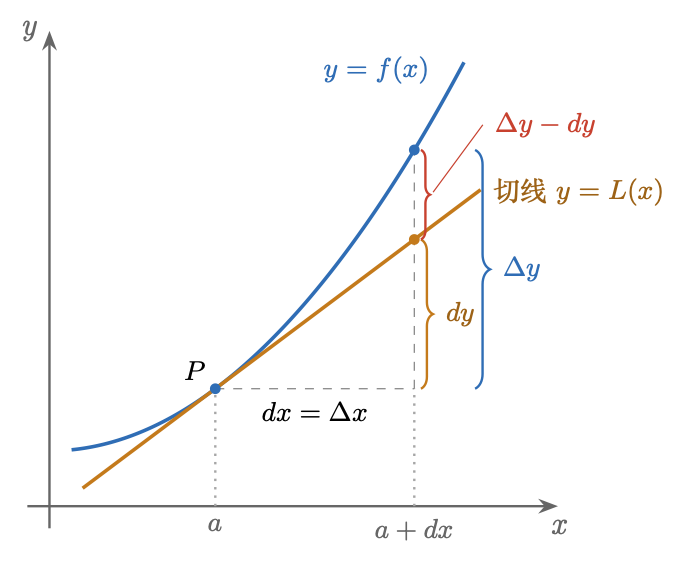
定义框中的 \(L(a+dx)-f(a)=dy\) 也由此得出:4.6 节的线性近似 \(L\) 就是这条切线,\(L(x)=f(a)+f'(a)(x-a)\),所以
即 \(dy\) 是 \(L\) 从 \(a\) 到 \(a+dx\) 的增量,\(\Delta y\) 是 \(f\) 的增量。在 \(a\) 附近 \(L\approx f\),所以 \(dy\approx\Delta y\),\(dy\) 就是 \(\Delta y\) 的切线近似。
以例题 8 为例:\(f(x)=\sqrt x\),\(a=9\),\(dx=0.2\),
\(dy\) 就是例题 8 中的 \(L(9.2)-3\);\(dy\) 与 \(\Delta y\) 相差约 \(0.0002\),也就是例题 8 的估计值与真值之差。\(dy\) 只需要一次乘法就能算出,而 \(\Delta y\) 往往不容易直接计算,这正是用 \(dy\) 近似 \(\Delta y\) 的原因。
Example 10 / 例题 10(误差传播)
The radius of a circle is measured as \(r = 10\) cm with a possible error of \(\pm 0.1\) cm. Estimate the resulting error in the computed area.
解 Solution
第一步(误差的含义):测量值 \(10\) 与真实半径之差记作 \(dr\),\(-0.1\le dr\le0.1\),即真实半径是 \(10+dr\)。用测量值算出的面积与真实面积相差
所以面积的误差可以用微分 \(dA\) 来估计。
第二步(求微分):\(A = \pi r^2\),\(dA = 2\pi r\,dr\)。代 \(r=10\),\(dr = \pm 0.1\):
(对照:\(dr=0.1\) 时准确的差是 \(\pi(10.1)^2-\pi(10)^2=2.01\pi\approx6.31\),与 \(2\pi\) 很接近。)
第三步(相对误差):误差与测量值之比叫做相对误差。面积的测量值是 \(A=\pi(10)^2=100\pi\),所以
面积的相对误差约是半径的 \(2\) 倍。这对任何半径都成立:\(\dfrac{dA}{A}=\dfrac{2\pi r\,dr}{\pi r^2}=2\cdot\dfrac{dr}{r}\)。
答:面积误差约 \(\pm 2\pi\) cm\(^2\)。导数 \(\frac{dA}{dr}=2\pi r=20\pi\) 把半径的误差 \(0.1\) cm 换算成面积的误差 \(2\pi\) cm\(^2\);按相对误差算,半径差 1%,面积约差 2%。
- For \(y = x^3\), find \(dy\) when \(x=2\) and \(dx=0.05\).
求 \(dy\)。核对答案
\(dy = 3x^2\,dx = 12(0.05) = 0.6\) - A cube's edge measures \(5\) cm with error \(\pm 0.02\) cm. Estimate the error in the volume.
估计体积误差。核对答案
设棱长为 \(s\):\(dV = 3s^2\,ds = 3(25)(\pm0.02) = \pm 1.5\) cm\(^3\)
4.8洛必达法则L'Hospital's Rule
第一章用代数方法(约分、有理化)处理 \(\frac00\) 型。但 \(\dfrac{e^x-1}{x}\) 这种无法约分的 \(\frac00\) 型怎么办?学了导数之后,可以用导数来求这类极限:
If \(\displaystyle\lim_{x\to a}\frac{f(x)}{g(x)}\) is of the form \(\dfrac{0}{0}\) or \(\dfrac{\pm\infty}{\pm\infty}\), and \(f,g\) are differentiable near \(a\), then
provided the limit on the right exists or is \(\pm\infty\); the rule also applies as \(x\to\pm\infty\) and to one-sided limits.
(只要等式右边的极限存在或为 \(\pm\infty\))。\(x\to\pm\infty\) 及单侧极限同样适用。
L'Hospital's Rule may be used only when direct substitution gives \(\frac00\) or \(\frac{\infty}{\infty}\). So substitute first and write down the form you get—AP graders award a point for this step. Then differentiate the numerator and the denominator separately; this is not the Quotient Rule.
洛必达法则只能在代入后得到 \(\frac00\) 或 \(\frac{\infty}{\infty}\) 时使用。所以要先代入, 并把得到的形式写在卷面上(AP 阅卷有这一步的分);然后分子、分母分别求导——这不是商法则。
Why the Rule Works / 法则的来由
下面用 4.6 节的线性近似说明 \(\frac00\) 型最简单的情形:\(f(a)=g(a)=0\),\(f\)、\(g\) 在 \(a\) 处可导,且 \(g'(a)\ne0\)。 \(f\) 在 \(a\) 处的线性近似是 \(f(a)+f'(a)(x-a)=f'(a)(x-a)\),\(g\) 也一样,所以在 \(a\) 附近
两式相除,\(x-a\) 约去:
从图上看(图 6):两条曲线都经过 \((a,0)\),把 \(a\) 附近放大,它们几乎是两条过 \((a,0)\) 的直线,斜率分别是 \(f'(a)\) 和 \(g'(a)\)。在同一个 \(x\) 处,两条直线的高度都与 \(x-a\) 成正比,所以高度之比 \(\dfrac{f(x)}{g(x)}\) 接近斜率之比 \(\dfrac{f'(a)}{g'(a)}\)。
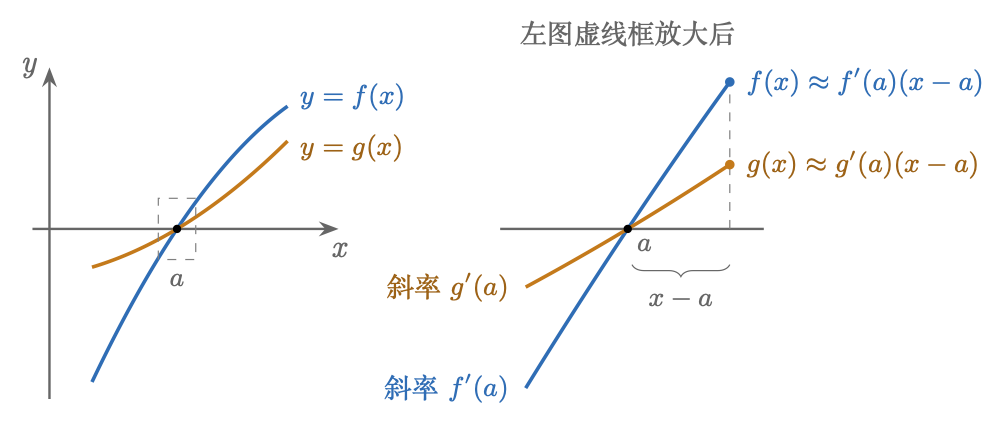
用导数的定义(第二章)可以把“约等于”写成准确的极限。因为 \(f(a)=g(a)=0\),
当 \(f'\)、\(g'\) 在 \(a\) 处连续时,\(\dfrac{f'(a)}{g'(a)}\) 就等于定理中右边的极限 \(\displaystyle\lim_{x\to a}\frac{f'(x)}{g'(x)}\)。 法则比较的是分子、分母各自在 \(a\) 附近变化的快慢,所以对分子、分母分别求导,而不是对整个分式用商法则。
以上是 \(\frac00\) 型且 \(g'(a)\ne0\) 时的理由。其他情形(\(g'(a)=0\) 时要连续使用,如例题 13;\(\frac{\infty}{\infty}\) 型;\(x\to\pm\infty\))的证明超出 AP 范围,这里不展开。
Example 11 / 例题 11
Evaluate
解 Solution
代入 \(x=0\):分子 \(e^0-1=0\),分母为 \(0\),是 \(\frac00\) 型,可用洛必达:
答:\(1\)。
Example 12 / 例题 12(\(\frac{\infty}{\infty}\) 型)
Evaluate
解 Solution
\(x\to\infty\) 时 \(\ln x\to\infty\)、\(x\to\infty\),是 \(\frac{\infty}{\infty}\) 型,可用洛必达:
答:\(0\)。这个结论值得记住:\(\ln x\) 比任何正次幂增长得慢; 用同样的方法可证 \(x^n\) 比 \(e^x\) 增长得慢(见 Practice)。
Example 13 / 例题 13(可以连用)
Evaluate
解 Solution
代入:\(\frac00\)。第一次洛必达:
还是 \(\frac00\),再用一次洛必达(也可以直接用 \(\lim\frac{\sin x}{x}=1\)):
答:\(\dfrac12\)。每次继续使用前都要重新代入检查——确认仍是未定式。
- Redo \(\displaystyle\lim_{x\to 0}\frac{\sin x}{x}\) with L'Hospital's Rule.
用洛必达重新计算。核对答案
代入得 \(\frac00\);\(\displaystyle\lim_{x\to 0}\frac{\cos x}{1} = 1\)(只作验算:2.10 节的 \((\sin x)'=\cos x\) 本身是由这个极限推出的,所以不能用洛必达来证明它) - Evaluate \(\displaystyle\lim_{x\to 2}\frac{x^2-4}{x-2}\) twice—by factoring and by L'Hospital—and check they agree.
两种方法各做一遍,核对一致。核对答案
两种方法都得 \(4\) - \(\displaystyle\lim_{x\to\infty}\frac{x}{e^x}\)
核对答案
\(\frac{\infty}{\infty}\) 型;\(\displaystyle\lim_{x\to\infty}\frac{1}{e^x}=0\) - \(\displaystyle\lim_{x\to 0}\frac{e^{2x}-1}{\sin x}\)
核对答案
代入得 \(\frac00\);\(\displaystyle\lim_{x\to0}\frac{2e^{2x}}{\cos x} = 2\) - May L'Hospital be applied to \(\displaystyle\lim_{x\to 2}\frac{x+3}{x-1}\)? Why? Find the limit.
能用洛必达吗?为什么?求出极限。核对答案
不能:代入得 \(\dfrac{5}{1}\),不是未定式;极限就是 \(5\)
4.9AP 高频题型AP-Style Problems
Example 14: Related Rates in Context / 情境相关变化率
An oil spill spreads in a circle. Its area increases at a constant rate of \(8\pi\) m\(^2\)/min. How fast is the radius increasing when the radius is \(2\) m?
解 Solution
\(A = \pi r^2\),对 \(t\) 求导:
代入 \(\dfrac{dA}{dt} = 8\pi\),\(r=2\):
答:\(2\) m/min。
Example 15: When Is It Speeding Up? / 何时加速(MCQ 高频)
A particle has velocity
On which intervals is the particle speeding up?
解 Solution
符号:\(v>0\) 于 \((0,1)\cup(3,4)\),\(v<0\) 于 \((1,3)\);\(a<0\) 于 \((0,2)\),\(a>0\) 于 \((2,4)\)。
同号区间:
答:\((1,2)\cup(3,4)\)。这是 AP 常考的 MCQ 题型,画双符号轴可以避免漏判区间。
Example 16 / 例题 16(洛必达)
解 Solution
代入是 \(\frac00\)。洛必达:
(也可以不用洛必达:\(\frac{\sin 3x}{5x} = \frac35\cdot\frac{\sin 3x}{3x}\to\frac35\)。)
答:\(\dfrac35\)。注意链式法则:\(\sin(3x)\) 的导数含因子 \(3\)。
- A square's area grows at \(24\) cm\(^2\)/s. How fast is the side growing when it is \(6\) cm?
边长 \(6\) cm 时边长增长多快?核对答案
\(24 = 2(6)\,\dfrac{ds}{dt} \Rightarrow \dfrac{ds}{dt} = 2\) cm/s - \(\displaystyle\lim_{x\to 0}\frac{\tan(2x)}{x}\)
核对答案
代入得 \(\frac00\);\(\displaystyle\lim_{x\to0}\frac{2\sec^2(2x)}{1} = 2\)
4.10章末练习Chapter Exercises
Part A: True or False / 概念判断
- 质点加速当且仅当 \(v(t)\cdot a(t) > 0\)。
核对答案
True(\(v\)、\(a\) 同号时速率增大) - 相关变化率问题中,所有随时间变化的量都必须在求导之后才能代入数值。
核对答案
True(先代入会把变量当成常数,变化率变成 \(0\)) - 线性近似 \(L(x)\) 就是 \(f\) 在 \(x=a\) 处的切线。
核对答案
True(\(L(x)=f(a)+f'(a)(x-a)\) 正是切线方程) - 洛必达法则适用于任何商的极限。
核对答案
False(只能用于 \(\frac00\)、\(\frac{\infty}{\infty}\) 型) - speed \(=|v(t)|\)。
核对答案
True(速率是速度的绝对值)
Part B: Motion / 运动分析
- \(s(t)=t^3-3t^2\)(\(t\ge 0\))。求质点静止的时刻、向左运动的区间,以及加速的区间。
核对答案
\(v=3t(t-2)\):静止 \(t=0,2\);向左 \((0,2)\);\(a=6t-6\):加速 \((0,1)\cup(2,\infty)\) (\((0,1)\):\(v<0,a<0\);\((2,\infty)\):\(v>0,a>0\)) - \(v(t)=t^2-9\)(\(t\ge0\))。质点何时向右运动?求 \(a(2)\)。
核对答案
\(t>3\) 向右;\(a(2)=4\) - \(v(1)=-6\),\(a(1)=2\)。求此刻速率,并判断加速还是减速。
核对答案
速率 \(6\);异号,减速 - \(s(t)=\cos t\)。求 \(t=\dfrac{\pi}{2}\) 时的速度、速率与运动方向。
核对答案
\(v=-\sin t\),\(v\left(\frac{\pi}{2}\right)=-1\):速率 \(1\),向左
Part C: Related Rates / 相关变化率
- 圆半径以 \(2\) cm/s 增大。\(r=6\) 时面积增长多快?
核对答案
\(2\pi(6)(2) = 24\pi\) cm\(^2\)/s - 球体积以 \(32\pi\) cm\(^3\)/s 增大。\(r=2\) 时半径增长多快?
核对答案
\(32\pi = 4\pi(4)\,r' \Rightarrow r' = 2\) cm/s - 13 ft 梯子靠墙,梯脚以 \(3\) ft/s 滑离。梯脚离墙 \(12\) ft 时梯顶下滑多快?
核对答案
\(x=12\) 时 \(y=5\):\(12(3)+5y'=0 \Rightarrow y' = -7.2\) ft/s,梯顶以 \(7.2\) ft/s 的速率下滑 - 倒圆锥水箱 \(r=\dfrac h2\),注水 \(5\) m\(^3\)/min。水深 \(2\) m 时水位上升多快?
核对答案
\(V=\dfrac{\pi}{12}h^3\):\(5 = \dfrac{\pi}{4}(4)\,h' \Rightarrow h' = \dfrac{5}{\pi}\) m/min - 两船同时同点出发,一船向北 \(12\) km/h,一船向西 \(5\) km/h。1 小时后两船距离增大多快?
核对答案
\(z=13\):\(z' = \dfrac{12(12)+5(5)}{13} = \dfrac{169}{13} = 13\) km/h
Part D: Linearization and Differentials / 线性近似与微分
- 写出 \(f(x)=\sqrt x\) 在 \(a=25\) 处的线性近似,并估计 \(\sqrt{25.6}\)。
核对答案
\(L(x) = 5+\dfrac{x-25}{10}\);\(\sqrt{25.6}\approx 5.06\) - 用线性近似估计 \((0.98)^4\)。
核对答案
\(1+4(-0.02) = 0.92\) - \(y=\sin x\)。在 \(x=0\)、\(dx=0.2\) 时求 \(dy\)。
核对答案
\(dy = \cos(0)\cdot 0.2 = 0.2\) - 圆半径测得 \(8\) cm,误差 \(\pm 0.05\) cm。估计面积误差。
核对答案
\(dA = 2\pi(8)(\pm 0.05) = \pm 0.8\pi \approx \pm 2.5\) cm\(^2\)
Part E: L'Hospital's Rule / 洛必达法则
- \(\displaystyle\lim_{x\to 0}\frac{e^{3x}-1}{x}\)
核对答案
代入得 \(\frac00\);\(\displaystyle\lim_{x\to0}\frac{3e^{3x}}{1}=3\) - \(\displaystyle\lim_{x\to 1}\frac{\ln x}{x-1}\)
核对答案
代入得 \(\frac00\);\(\displaystyle\lim_{x\to1}\frac{1/x}{1} = 1\) - \(\displaystyle\lim_{x\to \infty}\frac{x^2}{e^x}\)
核对答案
\(\frac{\infty}{\infty}\) 型,洛必达两次:\(\frac{2x}{e^x}\to\frac{2}{e^x}\to 0\),极限为 \(0\) - \(\displaystyle\lim_{x\to 2}\frac{x-2}{x^2+4}\)(小心!)
核对答案
代入得 \(\dfrac{0}{8} = 0\):分母不为 \(0\),不是未定式,不能用洛必达(误用会得到 \(\frac14\));极限为 \(0\)
4.11本章小结Unit Summary
Key Ideas / 核心知识
- speed \(=|v|\);加速 \(\iff v,a\) 同号,减速 \(\iff\) 异号——用双符号轴判断。
- 情境解释三要素:时刻、速率带单位、方向;“量在增、率在减”两层要分清。
- 相关变化率五步:图 → 方程 → 对 \(t\) 求导 → 代值 → 单位; 先求导,再代入数值。三类关系:勾股、相似三角形、几何公式(圆锥先用 \(r\)-\(h\) 关系消元)。
- 线性近似 \(L(x) = f(a)+f'(a)(x-a)\):用切线近似曲线,切点要选得近且便于计算。
- 微分 \(dy = f'(x)\,dx\):用于估计误差传播。
- 洛必达:只用于 \(\frac00\)、\(\frac{\infty}{\infty}\) 型;先代入检查、可连续使用、分子分母分别求导。